
Kyle Rankin @kyle@librem.one
- Personal Site
- https://kylerank.in
- Personal Bibliography
- https://kylerank.in/writing.html
Admin
Technical author, FOSS advocate, public speaker, Linux security & infrastructure geek, author of The Best of Hack and /: Linux Admin Crash Course, Linux Hardening in Hostile Networks and many other books, ex-Linux Journal columnist.
Joined Apr 2019
@apples_and_pears Thank you!
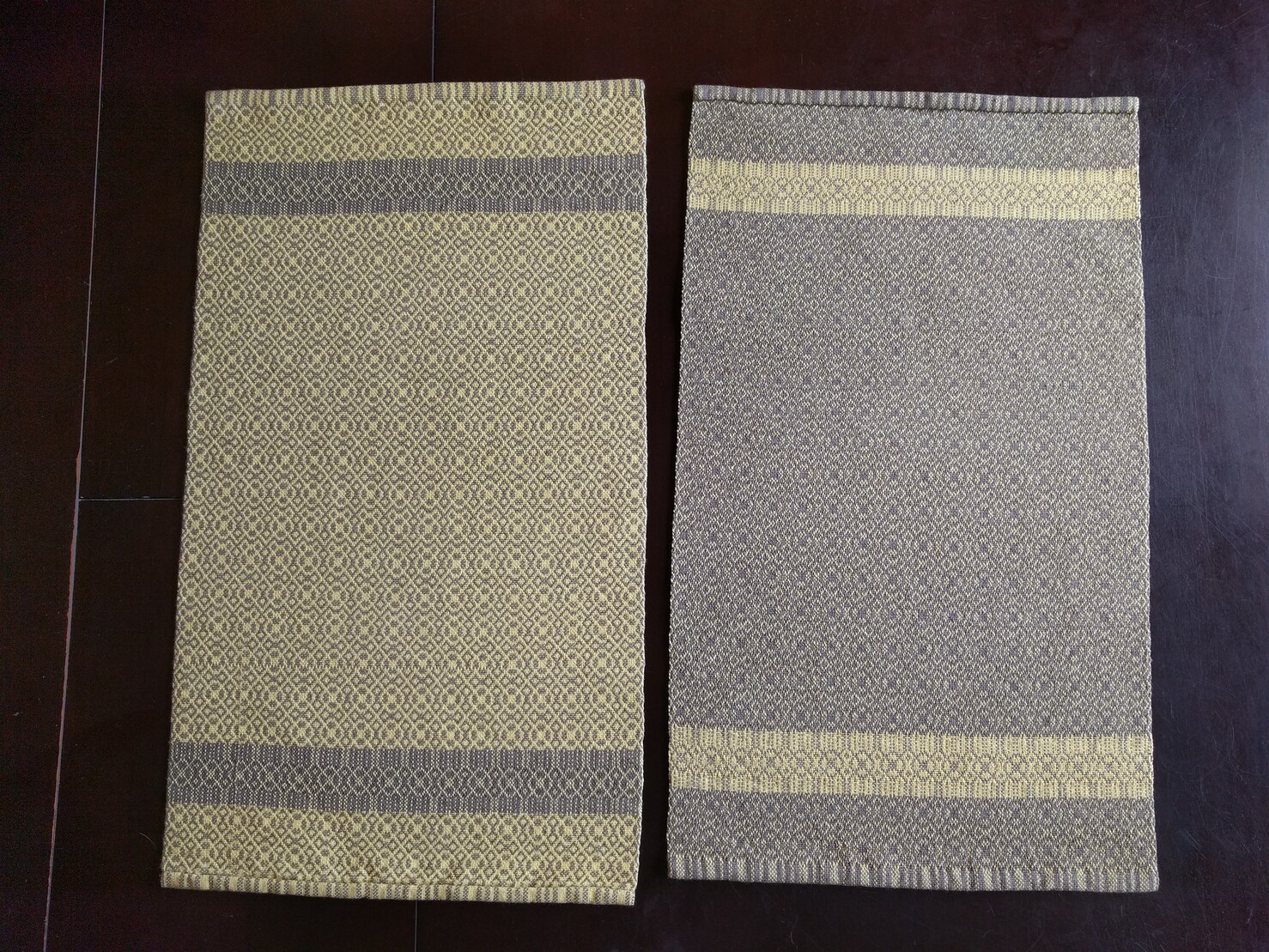
My towels are finished! I handstitched the hems with a felling stitch using matching thread so it would be invisible, and because this is a reversible pattern and has no "right" side, I put one hem on each side of the towel. In this picture you can see what each side looks like. The one on the left (with some treadling mistakes) I will keep and the one on the right will be submitted to a competition.
@CaramelizedShallots It's OK, I was still able to make two towels, and ultimately I only need one good one. This is for a weaving competition and my plan was to weave three and submit the best one.
@golemwire Thanks! Yeah, the stepper motor is being controlled by an old Raspberry Pi I had lying around + an Adafruit Motor Hat.
@Bloomfer I was inspired by this @hackaday post: https://hackaday.com/2023/01/23/knitting-clock-makes-you-a-scarf-for-next-year/ and thought "Hmm, I bet I could make one of those..."
@tyler OK, I'll definitely consider it!
@Bloomfer The knitting machine in the middle is essentially a sock knitting machine (look up Sentro 22-hook knitting machine). They also make a 48-hook model that is much larger. I started this project with one of those but the resulting clock was far too big.
@tyler No idea at this point, I'm still finishing up this design. I imagine it wouldn't be cheap as the raw components (knitting machine, electronics, 3D-printed plastic) adds up. That said, I hope to write up the steps in a simple enough way that anyone with access to a 3D printer and basic electronics know-how could make one.
@Bloomfer It makes a long tube that you could turn into a sock I imagine. The goal is to print one row per day for a year, and at the end of the year have a narrow scarf. We plan to add bands of colors for notable days throughout each year.
@blinken Thanks! I'm trying to take a lot of pictures and do plan to write something up about it and publish my 3D designs when I'm done.
@apples_and_pears Yes, there is a small switch to disable carries that you hold with your thumb while pressing the complementary digits on the comptometer, for subtraction/division.
I thought some of you might find it interesting to see a short video of the knitting clock in action. I'm simulating multiple days here, one complete rotation (day) at a time, with a short pause in between.
This is a lot louder than the final clock will be, because I'm using faster and more powerful double steps for these steps. The actual on-the-hour stitches will use quieter, slower, microsteps.
@apples_and_pears I tend to prefer the Monroe myself, although I also like the Facit approach too (both are barely visible on the right side of this picture).
I prefer Comptometers for basic addition and multiplication but will go for a Monroe or Facit any day when I need to divide.
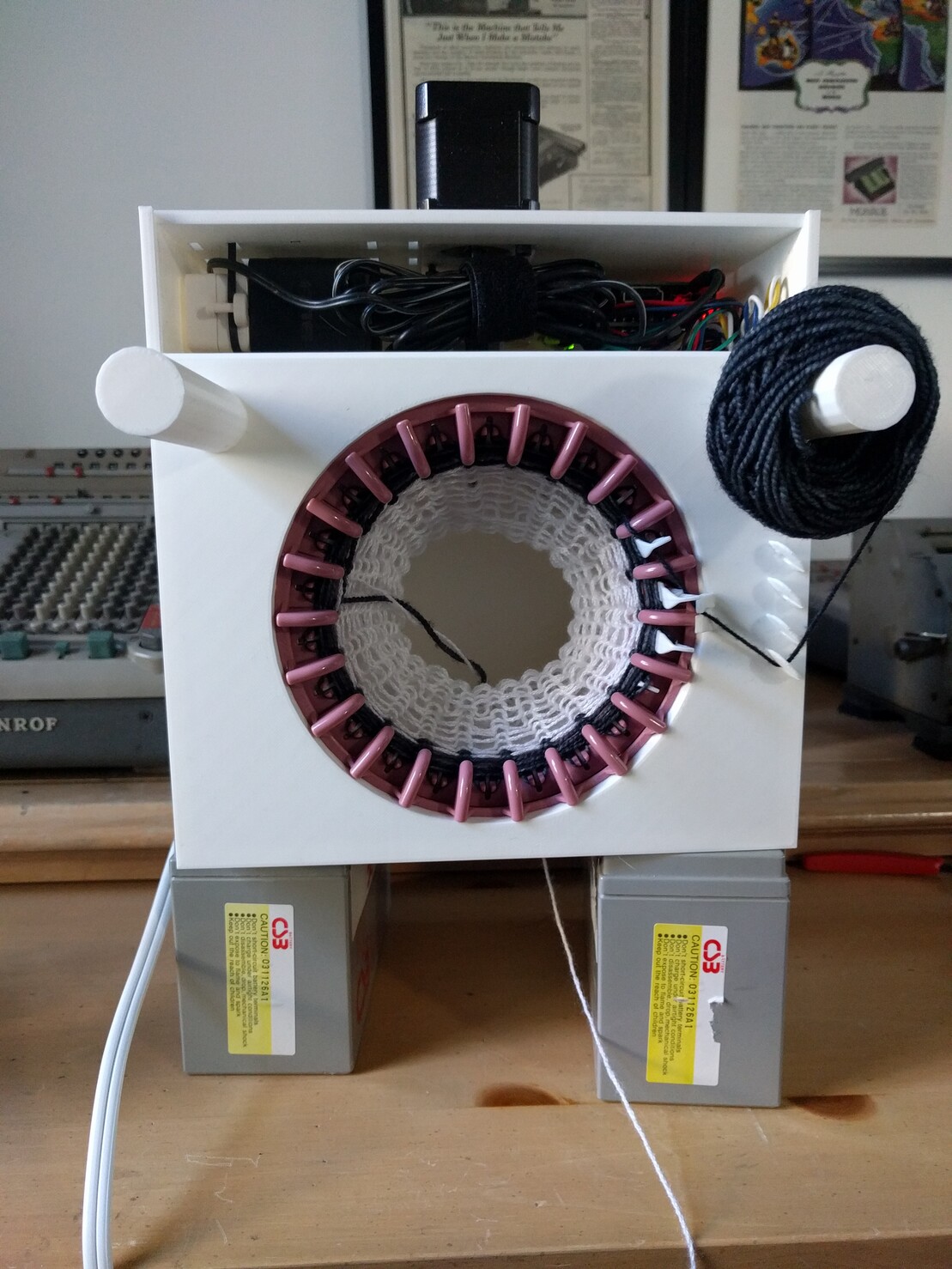
More progress on my knitting clock. I have finished designing and printing the bottom half of the "top" of the case that covers the knitting machine and provides a spool and tensioning guides for the yarn.
Here you can see it after I set up some white waste yarn and then switched to black yarn. I simulated a day or two's worth of knitting and then let it auto-progress a stitch every hour overnight.
Next I will design the "roof" for the clock.
I was on FLOSS Weekly yesterday, and had a great time talking with @dsearls and @shawnp0wers.
Check it out to hear me talk about the chip supply chain crisis in toilet paper terms, my history with and vision for convergence, and culture clashes in the FLOSS community.
https://twit.tv/shows/floss-weekly/episodes/721?autostart=false
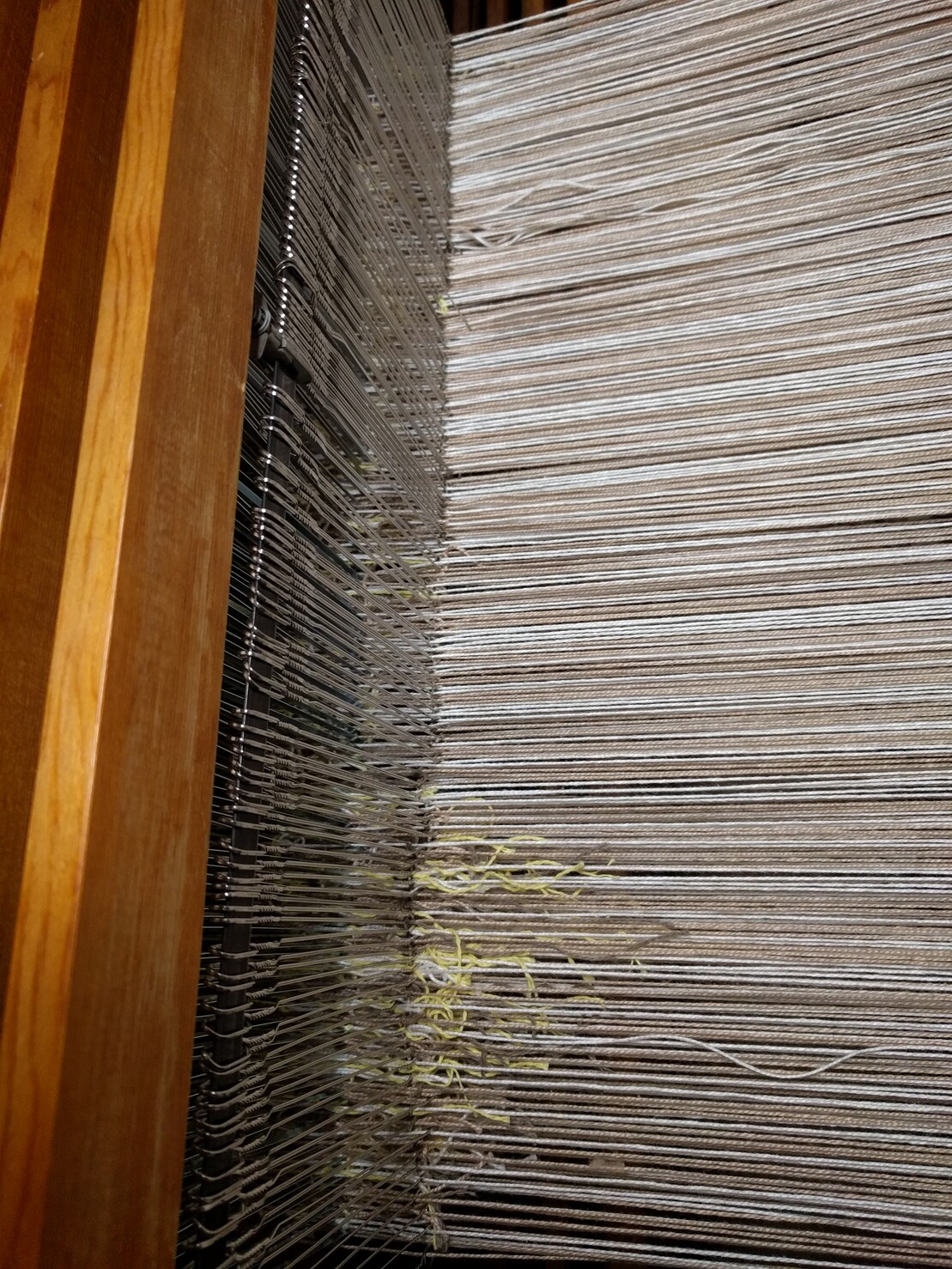
Well I think I'm calling it quits on this towel set early. This is the last in a long series of warp threads that came loose from the weaver's knot that attached it to the previous warp.
That by itself I could deal with, but what is worse is that all of the loose warp threads on either side of the weaver's knot are now tangling and making it almost impossible to get a shed without separating them each time the shed changes. I don't think I will tie onto an old warp in the future.
Kyle Rankin
boosted


#emacs with #convergence on the #purism #librem5 with a Nexdock 2. I hope this idea catches on more and more!

@triantares Yes, I ultimately used mine as a "crash cart" for a headless server in my house, and eventually that HDMI port broke. I still have the hardware in case some day I feel motivated to repair it.
"I don't like how fragmented Android is and how beholden you are to your carrier to get OS upgrades on your device. I also don't like that all of my favorite Linux apps can't be ported over easily. " 2/2
Of course this pull quote shows that some things haven't changed:
"I'll be honest, I don't really like Android. I want a true Linux distribution in my pocket, not a phone OS where you need a special app to do anything. All of the pre-installed junkware you get from your carrier reminds me of Windows desktops. I don't like that you have to sneak around and root the device to use it truly how you want (and to get a halfway usable terminal)." 1/2
- Personal Site
- https://kylerank.in
- Personal Bibliography
- https://kylerank.in/writing.html
Admin
Technical author, FOSS advocate, public speaker, Linux security & infrastructure geek, author of The Best of Hack and /: Linux Admin Crash Course, Linux Hardening in Hostile Networks and many other books, ex-Linux Journal columnist.
Joined Apr 2019