

Kyle Rankin @kyle@librem.one
- Personal Site
- https://kylerank.in
- Personal Bibliography
- https://kylerank.in/writing.html
Admin
Technical author, FOSS advocate, public speaker, Linux security & infrastructure geek, author of The Best of Hack and /: Linux Admin Crash Course, Linux Hardening in Hostile Networks and many other books, ex-Linux Journal columnist.
Joined Apr 2019
@apples_and_pears For instance, I'm pretty well convinced that the unified UI you saw for full keyboard adder-listers starting in the 1920s had to do with Burroughs dominating the market (and acquiring most big competitors) and the remaining competitors in the market painting their own adder/listers to match the classic Burroughs black case/green felt under the keyboard design from the Model 1 so they could hope to replace Burroughs in some businesses.
@apples_and_pears I have a pretty good cross-section of different designs in my calculator collection, and the common thread seems to be that the UI is simply a method to expose whatever mechanically needed to be done behind the scenes. That combined with the patent issues meant every design had a different UI.
It's similar to certain Linux CLI applications I won't name where it's clear the developer simply exposed internal function calls instead of thinking about UX.
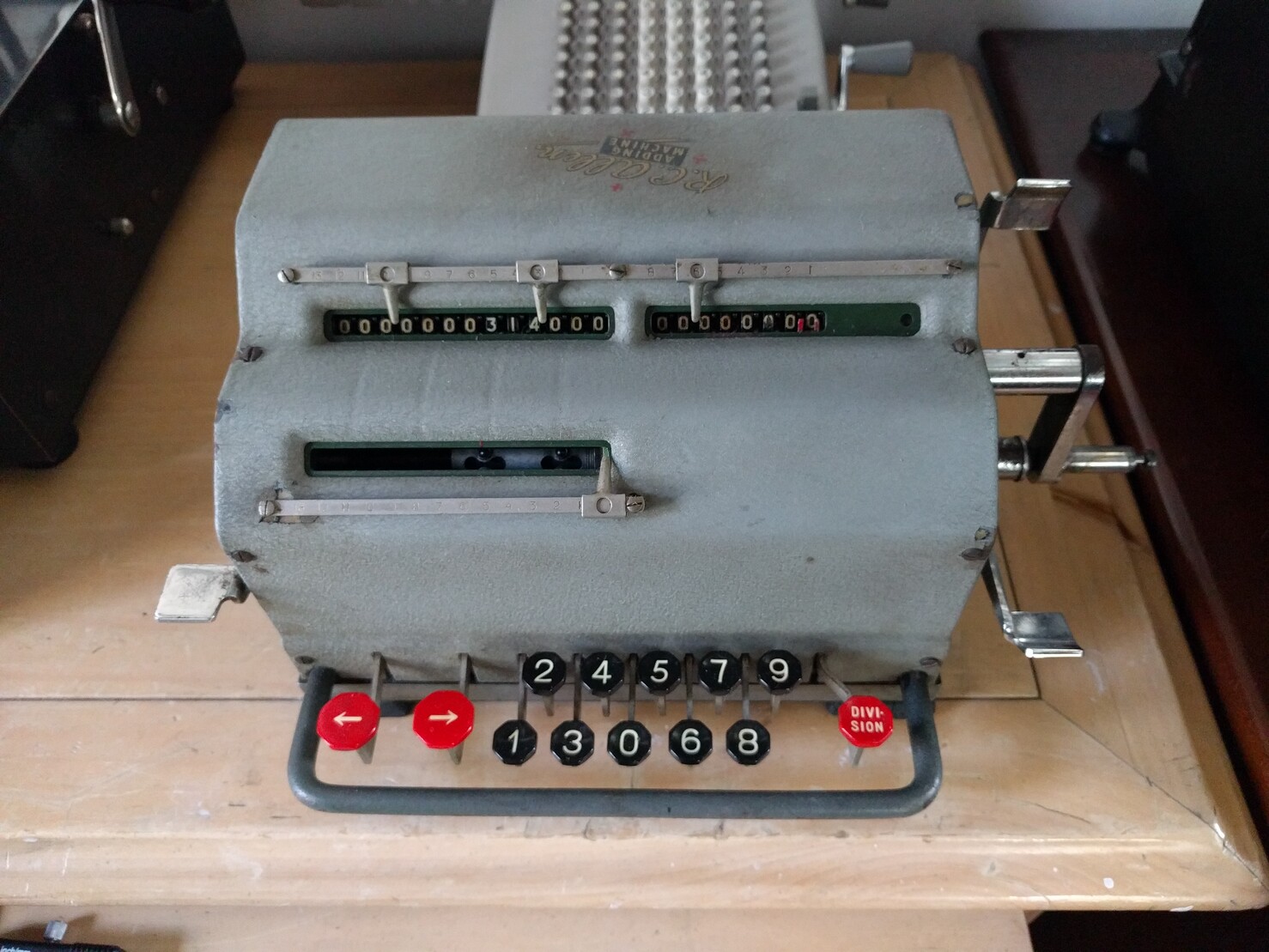
@apples_and_pears This is the RC Allen whitelabel of the Facit pinwheel calculator I was referring to before. Very unusual key layout but surprisingly nice to use.
The second attempt is looking good for this 3D printed case for my knitting clock. Along with fixing some mistakes in my design, I also modified it so that it could print for the most part without supports. There was one area where that was unavoidable, so I added in basic supports. While there is a little cleanup where it bridged there, it's much less than I saw when I enabled internal supports in the first print.
@Kymberly Interesting! I haven't done it in advance before and normally just shift the reed if I was off. I will have to try this for a future project.
@apples_and_pears Ahh that Dalton is different from my Facit clone, which is more an attempt to add pushbutton UI to a classic pinwheel design.
@apples_and_pears I have an RC Allen white label of a Facit adding machine like this in my collection. It's one of my favorite to use.
@kashhill You can't spell "disturbing" without "Bing"
Kyle Rankin
boosted

Last week, my colleague Kevin was ready to give up Google in favor of the new AI-powered Bing. https://www.nytimes.com/2023/02/08/technology/microsoft-bing-openai-artificial-intelligence.html This week, he writes about a chat with Bing's AI leaving him deeply unsettled after it told him about the many terrible things it's "shadow self" wanted to do and confessed its love repeatedly for him. The cycle from enchantment to terror with new technologies is really accelerating! https://www.nytimes.com/2023/02/16/technology/bing-chatbot-microsoft-chatgpt.html The convo transcript is worth a read. Unlocked: https://www.nytimes.com/2023/02/16/technology/bing-chatbot-transcript.html?unlocked_article_code=5L9j4UTGa2Sq9R0FulDKfmcq3aesNcqqwZkPBwsIW7EvqkbanIdsZU0hoKktwWijvrw8qobVzmdbyZfxtRjhZQWMN1Qi39t035TVJEllXwc9_zmJYNu_Y9gQ-8ROXYZ8ReuKsdz9WCv7bu_V75hZNZXipGPrv_h5g6phWp8GUX2DTCGQMjV-CTjJybDonBvQaR_kPJbX2zzNM8s4PROKIK32tEVmqGFG0Z1mfzUetZbXqKtz-3b7jFe4M4ylQHHbCnqtSyX4zN6HT4SLsCliddmSW4Aq5V5MZXuwzlSaLgLra8kE5mc1MQuP7cMU9jA6JiP7lhfRpgwcKeHKrGOCRiL21Bw&smid=url-share
@leimon Thank you!
You hit the nail on the head. The tangible nature of this hobby is one of the big things that appeals to me after spending so much of my career building either abstract things, ephemeral things, or even tangible things like tech books that fade after a few years. With this hobby I'm making physical objects I and others can use, in many cases objects that will outlive me, if taken care of.
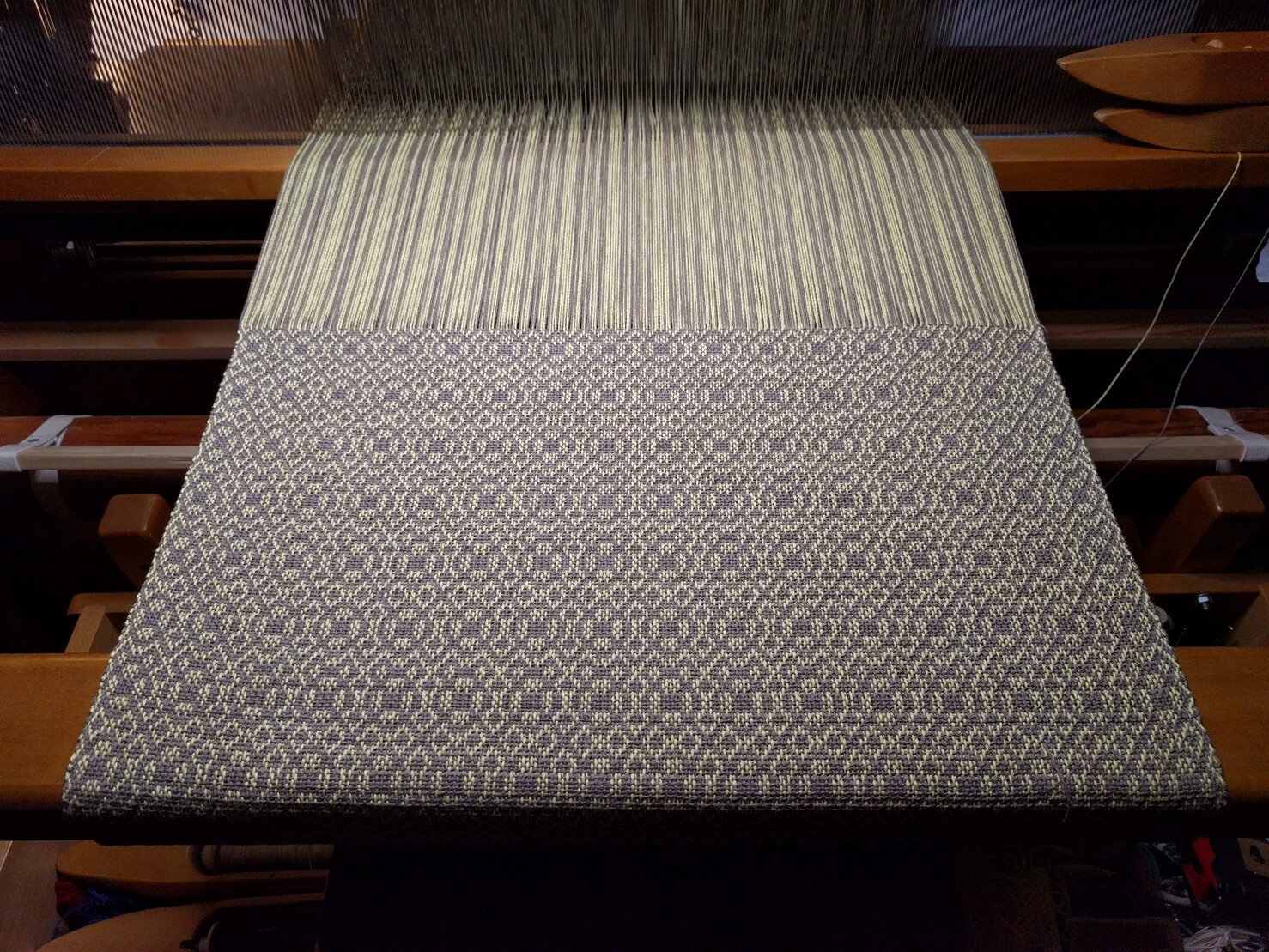
See if you can spot the treadling errors! I managed to make the same mistake three different times in pattern repeats so far. Combined with the threading mitsake from earlier, this is rapidly becoming the "warm up" towel where I hopefully get all of the mistakes out of my system before the next two.
@apples_and_pears Thank you!
I had to cancel the print. There were a few flaws in the model that I couldn't ignore and that I wasn't able to see in the model itself. In particular the button mounting brackets were not attached to the sides of the case but just floating 1mm from the case. Rookie mistakes.
It's ok. This will allow me to make a few other refinements that I noticed when printing, but that weren't important enough by themselves to cancel it.
@MaryPot I currently use an Ender 5 Pro, and as you can see I'm using up all of the available print area for this print! I've been very pleased with the quality of the prints when combined with the default Ender 5 printer profile in Prusaslicer.
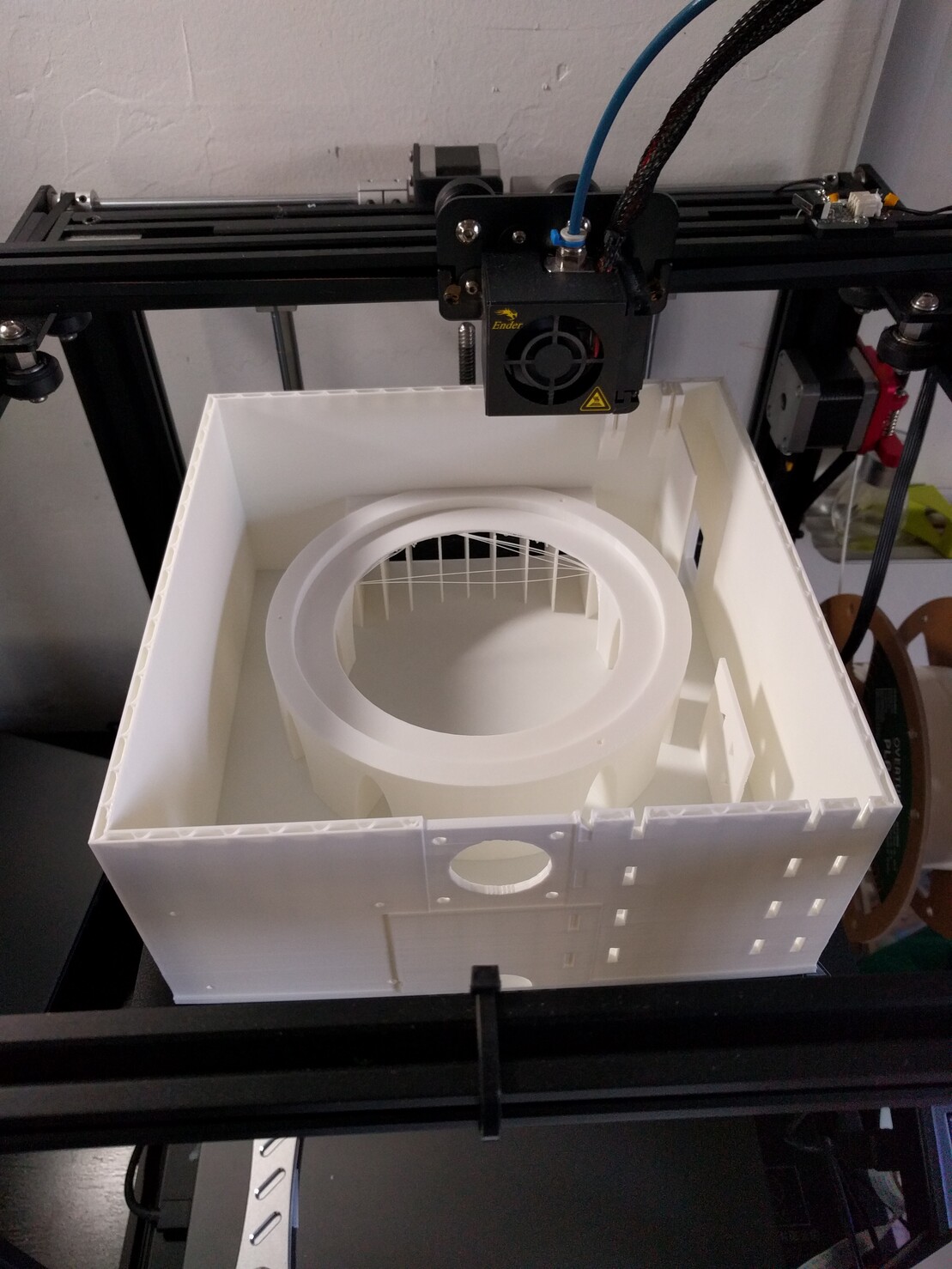
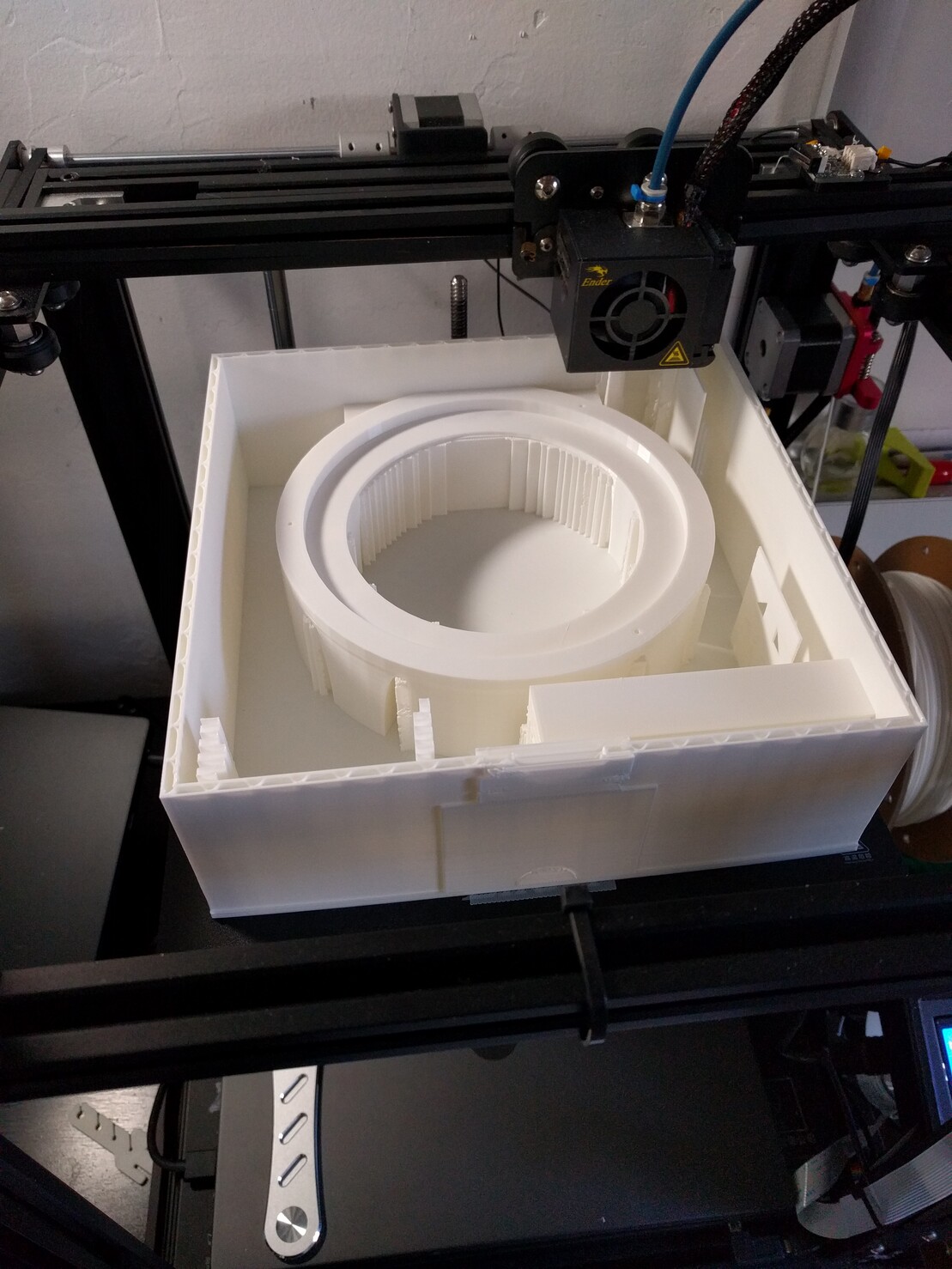
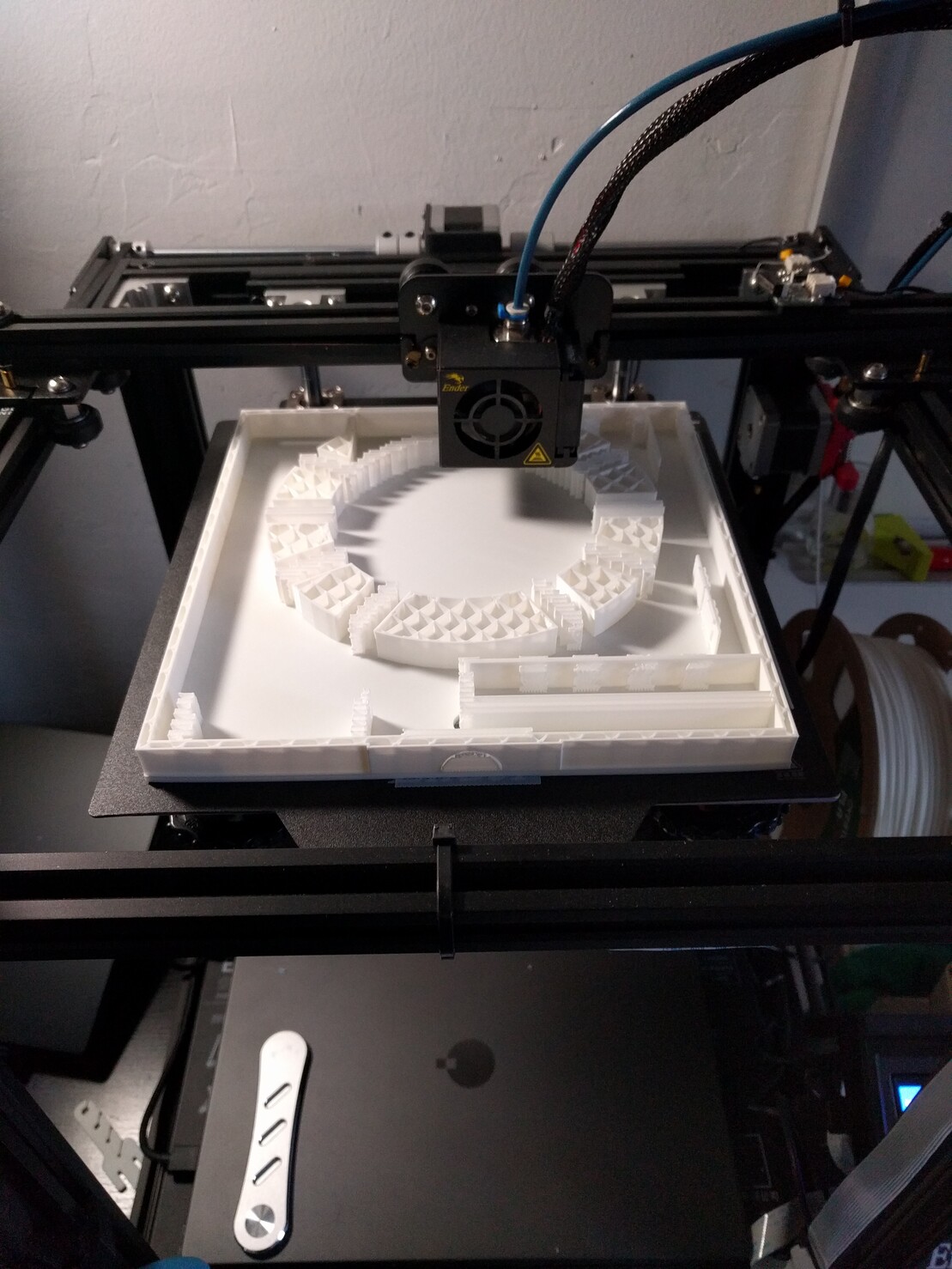
We are 40 hours in and the structure that holds the knitting machine itself is completed. All that is left are the walls which also have button and motor mounts in them.
Kyle Rankin
boosted

Audio over DisplayPort over USB-C, coming soon to a #Librem5 near you.
After almost 16 hours, the case for my knitting clock is starting to take shape. You can now make out the central structure that will hold the knitting machine itself in place. While I tried to reduce overhangs, due to the nature of this model there still are quite a few so there will be a lot of internal support material to remove when this is done.
@Nerdfest You could make a strong argument that Poker Face is essentially a reboot of Columbo for Gen-Xers.
I've been quiet about my hackaday-inspired knitting clock project ever since I decided to replace the 48-hook machine with a 22-hook model, but that's because I've been busy learning 3D modeling!
I realized the new 22-hook knitting machine fits on my 3D printer bed, so instead of a wooden case, I designed a custom case for it using Tinkercad. I just started an epic 2 day, 8-hour print of the case that takes up my entire print bed!
@apples_and_pears You could go back in with a tapestry needle and weave in a new thread to match the pattern of the old. That would be easier on a simpler pattern though (like a standard tabby or twill). Because this is doubleweave, you are essentially weaving two fabrics that are interlaced with each other in this dense cloth, so it would be more challenging.
In my case I put on enough warp for three towels and I will probably not go to the trouble for this one.
- Personal Site
- https://kylerank.in
- Personal Bibliography
- https://kylerank.in/writing.html
Admin
Technical author, FOSS advocate, public speaker, Linux security & infrastructure geek, author of The Best of Hack and /: Linux Admin Crash Course, Linux Hardening in Hostile Networks and many other books, ex-Linux Journal columnist.
Joined Apr 2019