
Hans-Christoph Steiner @eighthave@librem.one
Joined Aug 2019
Given the current political tides, it remains an open question which system will provide better outcomes. But it should be interesting to watch at least 😉
A central theme in my life is a constant comparison between #USA and #Austria. One notable difference is how #FreeSpeech is considered. Both countries value it highly. #US has the very strict #FirstAmendment while Austria allows some kinds of #government #regulation of #speech. More and more, US's strict #rights look like a product of their time: #Democracy for an #elite minority resisting a #king. Austria's 20th century approach puts more power in an educated populace to decide some regulation
Hans-Christoph Steiner
boosted
Discord will require a face scan or ID for full access next month
https://www.theverge.com/tech/875309/discord-age-verification-global-roll-out
Every project that uses Discord for their community thingy is now effectively saying: papers please, or you are not welcome in our community.
Every. Single. One.
Hans-Christoph Steiner
boosted

The recording from our Public Domain Day virtual event is now available!
🕵️ Investigate THE CASE OF THE DISAPPEARING COPYRIGHT to learn which works just entered the public domain—and why copyright is more complicated than it looks.
Watch the full recording ➡️ https://archive.org/details/the-case-of-the-disappearing-copyright
#PublicDomain #PublicDomainDay #Copyright #OpenCulture @AuthorsAlliance
Just arrived in Brussels for #FOSDEM, hope to see y'all soon!
@razze @mattdm @fdroidorg I am aware that Flathub acts like a distro. I am a user and supporter of Flathub. The problem I see with It is that not a very clear story of what the standards are. For some packages, they seem reviewed and clearly enforced, and others, not at all.
I should clarify that I do see the difference between Flathub and Obtainium. There is a continuum of distro-like behavior. Fedora/Debian are on one side, Obtainium on the other. Flathub seems to be somewhere in the middle
@mattdm thanks, that was a good read. It mirrors a lot of things we've been doing at @fdroidorg Basically, we're working on being the "distro" for the Android ecosystem, and providing a from-source, reviewed and integrated set of apps.
@jas @mjg59 I agree, the focus must be on the four freedoms and user freedom. Unfortunately, Google has proven quite masterful at maintaining control even when working with free software. AOSP and Chromium are two key examples. The key is that Google makes sure it is the upstream, while suppressing things that shift the power to the developer community around it. With AOSP, there is a big enough community to maintain it without Google. That requires them all getting separately organized.
@jas @mjg59 Sure "source available" would be an improvement over secret source code, but that is only one piece of the puzzle. Free software means all users are free to fix and deploy issues on their own schedule, regardless of what the copyright holder thinks. That is also a key piece of delivering trustworthy software.
@barthalion I now see there is a whole drama around that interview. I don't know if I'm going to wade into that whole thing, so I'll just say, I like how @mattdm described the role of the distro. That's what I was referring to.
Hans-Christoph Steiner
boosted


If you’re on Linux, there’s a good chance you use GNOME: it’s the default experience across Red Hat Enterprise Linux, Ubuntu, Debian, Fedora Workstation, Endless OS, and more. If you’re on another desktop, you still likely use components developed by GNOME contributors—or maybe you get apps from Flathub.
Want to become more than just a user? How about… a friend? 🥺 Become a Friend of GNOME to support GNOME, Flathub, and the work we do!
@barthalion I'm immersed in the basic research: Debian since 1997, FOSS Android since 2008, F-Droid since 2012, Flathub since years, etc. I also maintain stuff in Homebrew, and in the past contributed to the Fink package manager for macOS and used Cydia on iOS back in 2007
Hans-Christoph Steiner
boosted
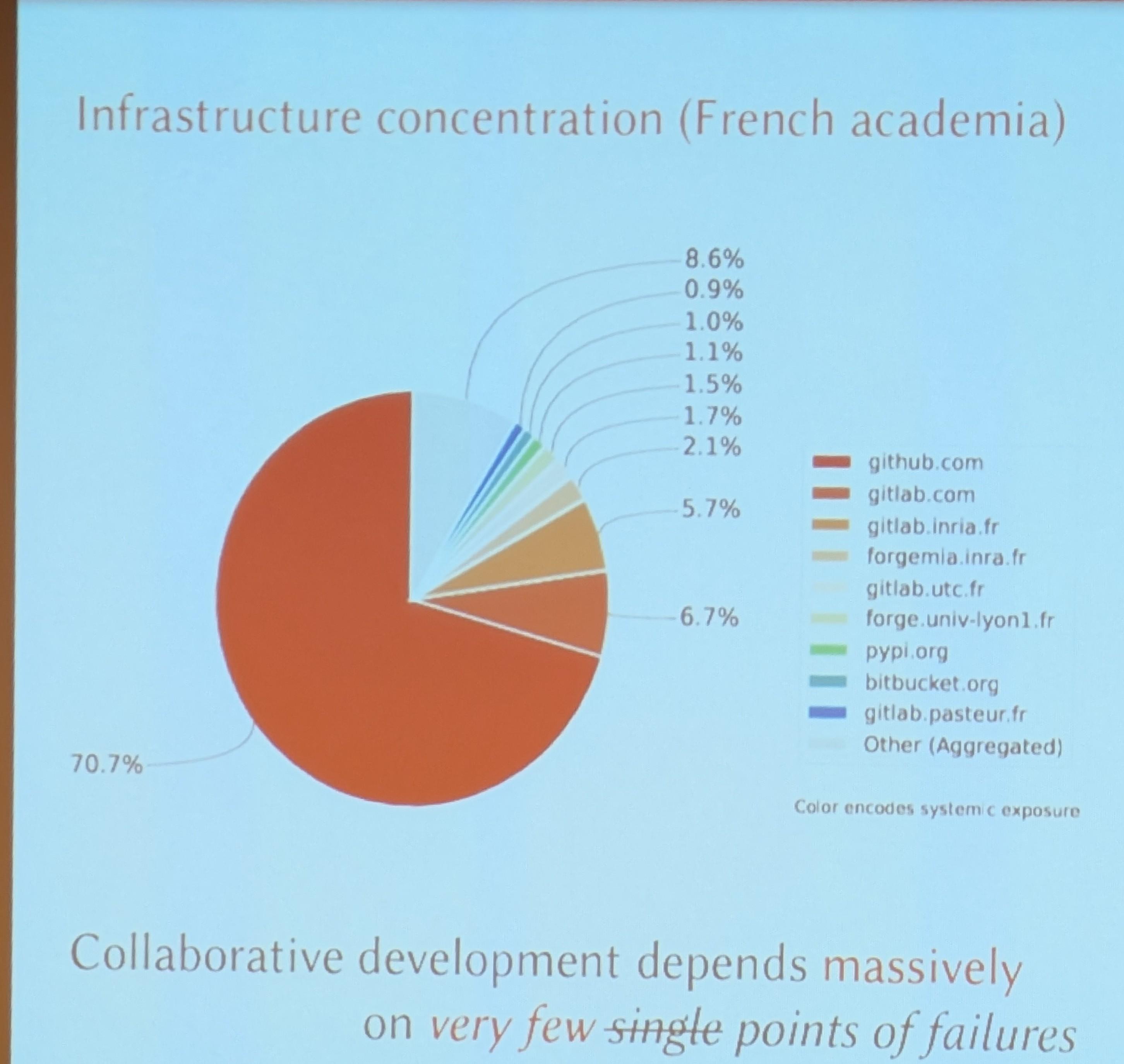
Today's digital #sovereignty data point, courtesy of #SWH2026. This chart shows who is hosting French research projects but I've no doubt it is representative of other sectors.
@mattdm it is great to have more resources explaining the value of distros. It feels like it is cool right now to talk about eliminating distros and going straight to the upstream. There are so many valuable things that approach leaves out. Do you know of any other good resources out there that explain the value of distros?
@mjg59 I agree that free software alone is not enough to make trustworthy software, but I have to emphasize that free software is a requirement for trustworthy software. That unlocks key practices like reproducible builds, public audits, etc. Without all that, the only option is "hope they are doing the right thing".
An popular idea in #OS development now is that the ideal system would have a #sandbox that allows users to install even untrusted apps safely. It is important to point out that this is pure fantasy. No system has ever come close to providing a sandbox good enough for that standard (e.g. #NSOGroup has maintained zero-click exploits to #iOS and #Android for years now). Having pure fantasy as a goal means other features will be broken in the name of trying to achieve the unachievable
Matt Miller, Project Leader of #Fedora, gives a nice overview of what makes #distros valuable. This applies to any distro that actually reviews the packages that they ship, including #FDroid #Debian etc. Something like #Flathub or #Obtainium do not behave like distros because they do not aim to review and standardize the packages they ship.
https://inv.nadeko.net/watch?v=oKP1hgdFJKo&t=187
(You can click "Watch on YouTube" from that site if you like that kind of thing 😉)
@strypey I've had this same thought about AppImages. I think it should be pretty easy to build and ship AppImages via F-Droid. The tricky part is whether there is good standardized metadata in AppImages. With Android and APK, the system enforces a number of key properties: a globally unique Application ID, a Version Code integer to determine which is the newer APK, only one APK per Application ID can be installed, etc. These come from the OS, so it could be tricky to handle with AppImage
@thomasdorr @ilumium Social media is a very profitable product. There have been massive resources devoted to helping people with addiction. Even in Austria, with a capable social state, relatively well resourced schools, addiction programs, etc, digital media addictions remain a problem. There is nowhere in the world that does not regulate addictive things, especially for children.
I'm also incredibly sad that these forces have turned software into addictive drugs. https://guardianproject.info/2021/02/18/usability-the-wonderful-powerful-idea-that-betrayed-us/
"Tourism is like fire, you can prepare your soup with it, but it can also burn your house down"
What a great analogy. I definitely see the "burn your house down" part in Austria. From what I've seen in the Balkans, it happening shockingly fast. And it looks like this current wave will mostly benefit foreign investors more than the locals. Real protections for nature help a lot.
https://www.theguardian.com/travel/2026/jan/28/volunteering-trip-protecting-vjosa-river-albania
Joined Aug 2019