
PINE64 stopped producing devices dependent on RAM/storage chips — so, for example, no more PinePhones.
What did we lose? From a phone perspective not much. Low-end hardware with no software support from the vendor. To be fair, we did lose FOSS modem firmware — on a device that is hardly usable.
Today, companies like Fairphone produce phones of far higher quality than the PinePhone or PinePhone Pro, while also supporting Linux kernel development for their devices.

@okias Let me grab that click bait 🤭 :
There are people that have other priorities like the amount of firmware on the device, separation of components on the PCB, no proprietary hypervisors, full control over all bootloaders, etc.
So I think as a community we have interest in devices like the @pine64 #PinePhone's or @purism 's #Librem5 to continue.
It's also good to have devices that ship Linux out of the box.
I'm not denying the value in some of these points, but in general I think HW without sustained software development is useless.
Purism did the development for Librem 5 and invested a lot to make this happen, while PINE64 released device able to run software stack developed by others. PINE64 had best position to bring good experience to the users, but it ended up as a poor toy.
Regarding to the shipping out-of-box Linux, we still have Sendero Linux shipping OP6T.

@okias @agx @pine64 Mobile Linux benefits from many angles. We invest heavily in the Librem 5 with ongoing hardware/software R&D and upstream contributions. A Librem 5 v2 is in the works.
PINE64 has also been instrumental in making mobile Linux hardware more accessible. Their community has driven significant interest, too; in fact, our CTO joined Purism after using a PP/PPP and getting more involved.
Mobile Linux needs both: serious R&D and hardware that more people can experiment with.

@hanscees @purism @okias @agx @pine64
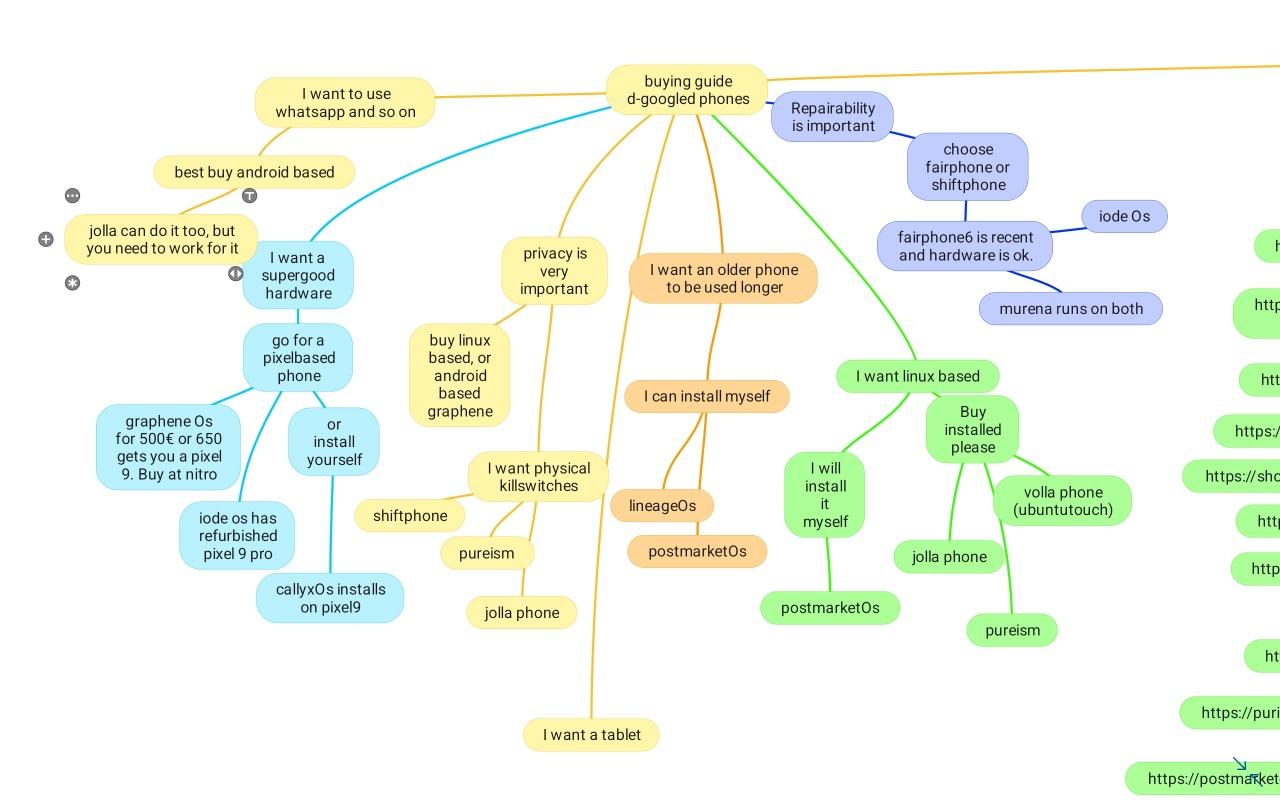
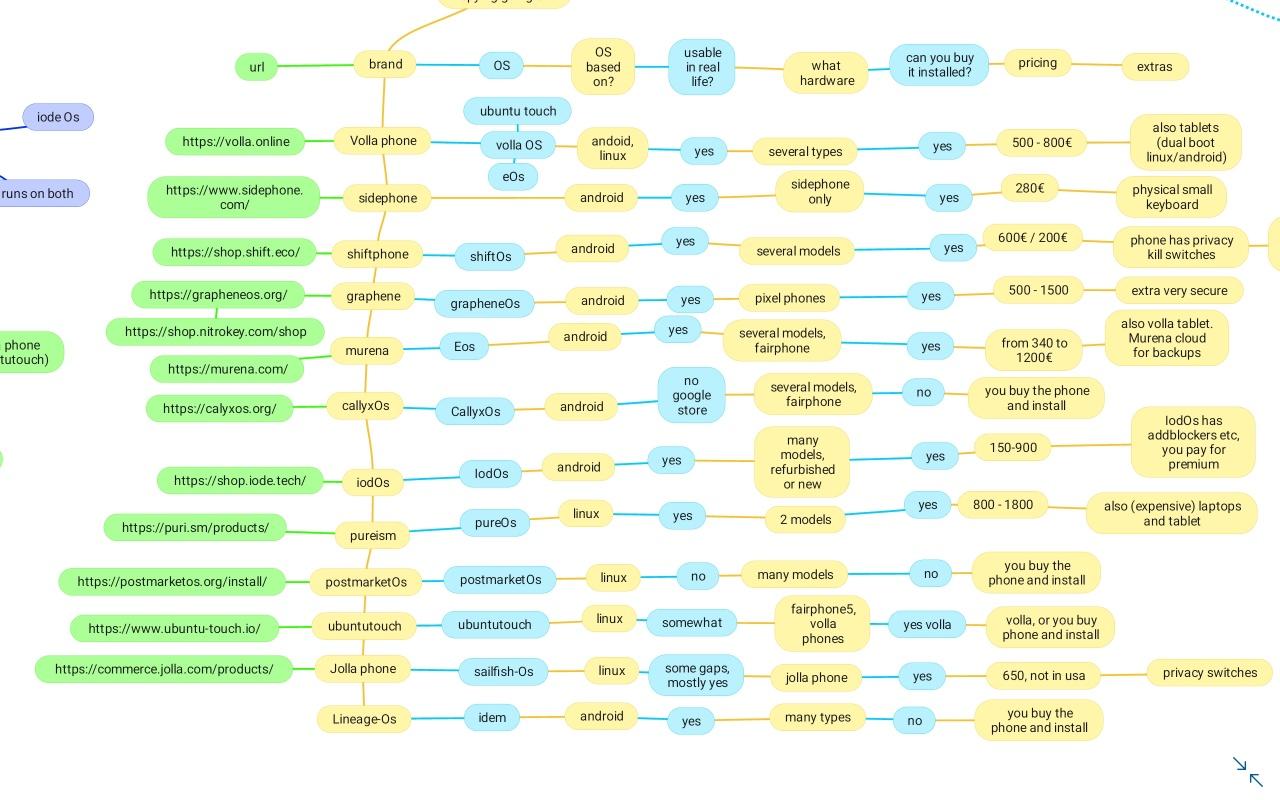
Nice mindmap. Notice that the #Librem5 is also pretty #repairable. For more details and instructions see: https://docs.puri.sm/Hardware/Librem_5/maintenance.html
#Repair components are for sale here: https://shop.puri.sm/accessories/
@hanscees @purism @okias @agx @pine64
Also, maybe you could consider adding the "supporting Linux #hardware" to the mindmap as well. By buying native Linux hardware you also provide financial support to the #MobileLinux ecosystem.
And also there are several ways to financially support #Linux #software development for mobile phones.
See for example:
- https://opencollective.com/postmarketOS
- https://ev.phosh.mobi/donate/
- https://shop.puri.sm/?s=PureOS+subscription
Probably there are more, but these are the ones I know of.
I think the difference between PINE64 / Purism and Volla / Jolla is that the former use mainline Linux kernels and the later use Android Kernels + libhybris. That makes a bit of a difference for the user in terms of hardware support, long term maintenance, etc and how userspace is layed out.
AFAIK they are. See e.g. https://en.wikipedia.org/wiki/Libhybris and https://docs.sailfishos.org/Tools/Hardware_Adaptation_Development_Kit/
while PureOS, postmarketOS, Mobian, BengalOS, pocketBlue, etc are mainline Linux based.
(and to add even more to the mix: There's a libhybris/android kernel flavored Debian called Droidian).
Yes, it's complicated, we notice that when talking to ppl with our association (@ev) at conferences. Once people realize it's mainline, they really get excited.

@hanscees @agx @ev @janvlug @purism @okias @pine64 No, not really. It's not about apps - you can run Android apps on any GNU/Linux phone, including Librem 5 or PinePhone. Distros like Sailfish, Ubuntu Touch or Droidian run on phones that can't run GNU/Linux natively and rely on parts of Android stack (such as device drivers) to function. libhybris is what makes it possible to run GNU/Linux apps on what's essentially an Android device; native devices don't need it.

@dos @agx @ev @janvlug @purism @okias @pine64
Ah, I am still learning here. So basically the problem for running native linux on a smartphone is the devicedrivers that are not opensource and only available in blobform for an android kernell with bionicC? Like the situation where with raspberryPi, that made opensource hardware accessable.
And so the solution route is either get opensource hardware, or use some sort of android layer in the kernell that uses those devicedriver blobs. So if thats correct getting big players opening up their source, or producing linux libc devicedrivers could also be possible in theory.
My son did his thesis on fuzzing the baseband chip in smartphones and I remember the total lack of documentation being a major hurdle.