
Old Fucking Punk @lwriemen@librem.one
#ShlaerMellor, #FunctionPointAnalysis, #punk, #environmentalist, #unionAdvocate, #anarchosocialist #freeSoftwareAdvocate #cooperativeLife #noLLMs
"with a big old lie and a flag and a pie and a mom and a bible most folks are just liable to buy any line, any place, any time" - Frank Zappa
Joined May 2019
“Today, Trump granted clemency to tax cheats, Wall Street crooks, billionaires and corrupt government officials,” said Senator Bernie Sanders. “Meanwhile, thousands of poor and working-class kids sit in jail for nonviolent drug convictions. This is what a broken and racist criminal justice system looks like.”
Old Fucking Punk
boosted

#Oil and #gas firms ‘have had far worse climate impact than thought’ | #Environment | The Guardian
A capitalist stating, ”Socialism under Krushev, Stalin and Mao”, has to be some variation of Godwin's Law.
Old Fucking Punk
boosted

The Next Big Grocery Strike Is Knocking on Safeway and Giant’s Door
Last April, more than 30,000 Stop & Shop grocery workers across the Northeast won a raucous 11-day strike against the company, beating back health care and pension cuts. Now, another major grocery strike has become a serious possibility, this time in and around the nation’s capital.
On Wednesday, UFCW Local 400 announced that it will be holding a strike vote early next month for more than 25,000 workers at hundreds of Giant Foods and Safeway stores across DC, Maryland, and Virginia. The union has separate contracts with Giant and Safeway, but both of those contracts have been expired since last October. Negotiations in the ensuing months proved fruitless, and now the union is preparing for what could become the first large strike of 2020.
Giant is owned by Ahold Delhaize, the same European conglomerate that owns Stop & Shop. Safeway is owned by Albertsons, the national grocery holding company controlled by the private equity firm Cerberus Capital Management. As is common in private equity deals, Cerberus is reportedly eyeing an IPO for Albertsons—placing great pressure on the company to spiff up its balance sheet, including labor and pension costs. Not coincidentally, those issues are now fueling the contract dispute that has brought these UFCW members to the point of a strike vote. In addition to pension cuts, the union says that the companies are pursuing cuts to health care funding, tight restrictions on benefit access for part time employees, and a plan to keep many new hires locked in a minimum wage salary for years.
Yesterday at the pub, I was doing some work, and had some friends sitting at the bar (all 20 years+ younger than me). We are all fairly progressive-minded people politically. A guy we didn't know, closer to my age, at the bar turned to me and thought he had spotted a Trump-supporting ally.
Poor guy left with his tail between his legs. #fucktheestablishment
Old Fucking Punk
boosted

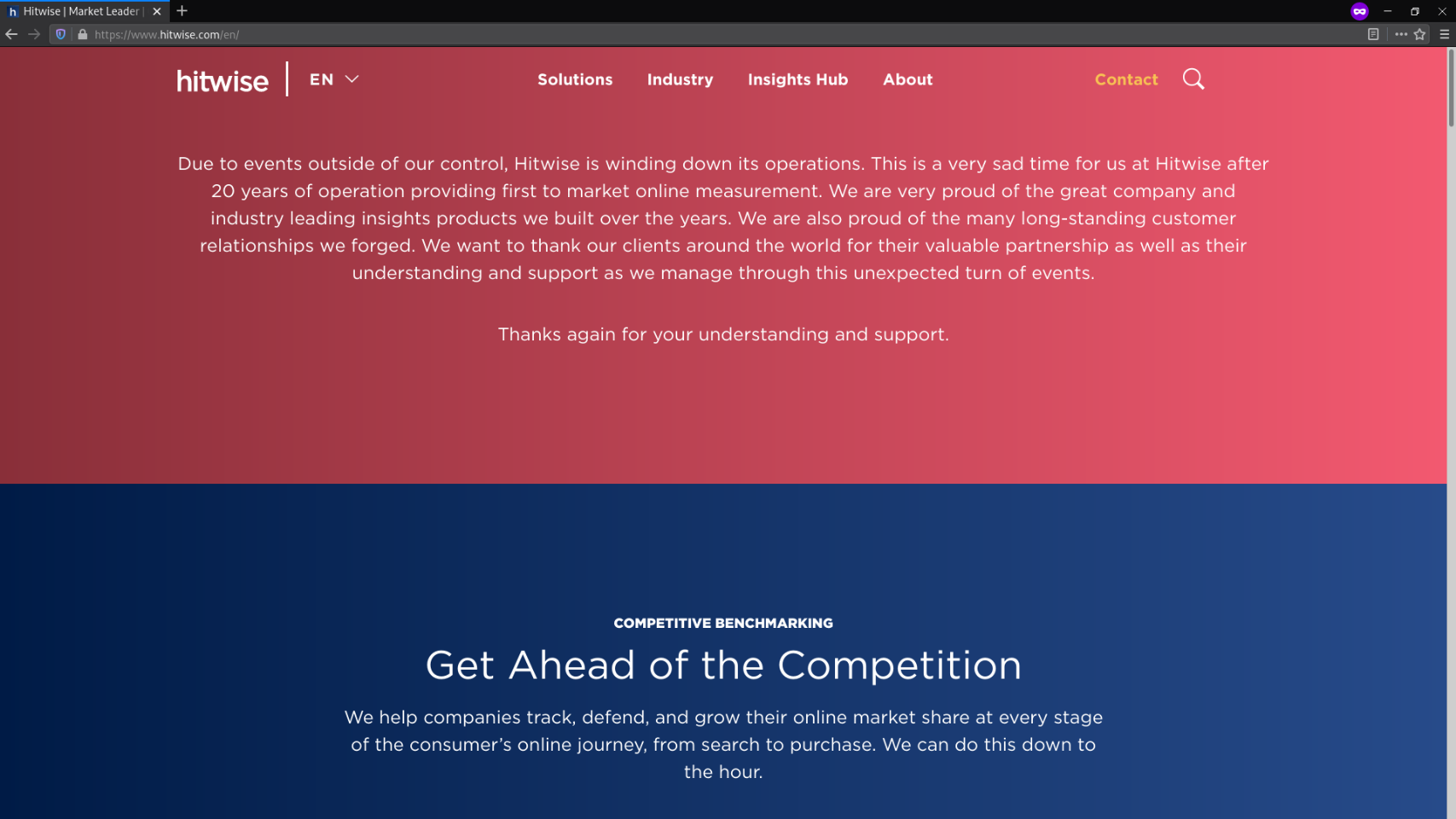
First JumpShot and now Hitwise. GDPR is starting to change the marketing world.
"Our primary partner is no longer in a position to provide us with data"
Hitwise used to "help companies track every stage of the consumer’s journey, from search to purchase down to the hour"
Old Fucking Punk
boosted

Bernie Sanders is now the frontrunner for the Democratic nomination. But the DNC is still trying to recruit someone to stop him. First it was Kamala Harris. Then it was Joe Biden. Now it’s Mike Bloomberg.
Old Fucking Punk
boosted

Wall Street investors react to climate change
Institutional investors are factoring climate risks into their investment decisions.
Old Fucking Punk
boosted
#Chinese people in #UK targeted with abuse over #coronavirus | World news | The Guardian
More evidence of disgraceful #racist behaviour.
Old Fucking Punk
boosted

“I Would Love Medicare for All”: A Nevada Culinary Union Member on Why She Supports Bernie Sanders
Bernie Sanders is leading in the Nevada polls, but he faces a major obstacle: One of the most powerful actors in state politics has come out swinging against his signature proposal—Medicare for All.
The 60,000-member Culinary Workers Union announced last Thursday that it will remain neutral in the Democratic primary this year. But in the past week, the union has sent out a series of communications to members warning, both directly and indirectly, that Sanders’ plan threatens its hard-won healthcare benefits.
One flyer circulated by the union read, “Some politicians promise . . . ‘You will get more money for wages from the company if you give up Culinary Health Insurance.’ These politicians have never sat at our bargaining table ... We will not hand over our healthcare for promises.”
Sanders’ opponents have seized on the opening to double down on arguments for preserving private health insurance—a position the union shares.
“There are 14 million union workers in America who have fought hard for strong, employer-provided health benefits,” tweeted former South Bend Mayor Pete Buttigieg. “Medicare for All Who Want It protects their plans and union members' freedom to choose the coverage that's best for them.”
Billionaire Tom Steyer, meanwhile, has started airing an ad in Nevada telling voters that “unions don’t like” Sanders’ healthcare plan.
Known nationally as a standard-bearer for militant workplace organizing, the Culinary Union hasn’t just won healthcare benefits—it runs its own 24-hour healthcare center and pharmacy, exclusively for members.
But some members are disillusioned that the union is flexing its muscle against a healthcare policy they believe could deliver a windfall to unions by freeing them to focus on other issues at the bargaining table.
In These Times spoke to Marcie Wells, a shop steward with Culinary Workers 226 who has worked at Jimmy Buffet’s Margaritaville inside the Flamingo Hotel and Casino for 16 years. Wells discussed Medicare for All, the union’s endorsement decision and her support for Bernie Sanders.
There was a lot of speculation as to whether the union might still endorse Joe Biden. What was your reaction to the decision not to endorse anyone in the primary?
[Union leaders] said early on that they were not sure if they were going to endorse. When they called this press conference, everyone expected that they were going to go ahead and endorse Biden, because they already said they weren’t endorsing. So why would you put together all that just to repeat yourself?
The literature they put out the night before was not so subtle. It had the words “one, two, three,” and three candidates in order [Editor’s note: Joe Biden, Pete Buttigieg and Amy Klobuchar are listed first on the flyer]. Everyone knows in the caucus, you rank your top three choices. But they’re not officially endorsing.
I think it sends mixed signals, and it’s disappointing that they’re not being straightforward.
Did the union poll members about the endorsement?
No, they didn’t. Typically, I get called for those types of things, because I’m a shop steward.
Talking one-on-one, a lot of members want Bernie. But when we’re in the setting of citywide meetings or things that are exclusive to shop stewards, there’s a clear message that, “the person who wants Medicare for All wants to take away our hard work.”
It’s disappointing as a progressive.
At a town hall the union held with Sanders in December, some members heckled over the issue of healthcare. Can you describe what you saw happen?
At this type of event, all the questions are planned. When Bernie started talking about healthcare, almost on cue, a group started chanting, “Union healthcare! Union healthcare!”
When a speaker said, “I don’t want to give up my insurance,” I yelled back, “I do!”
But aside from what felt like a staged protest, Bernie got a great reception, people were cheering. I mean, he’s the frickin’ union guy.
The culinary union has the reputation of having some of the best healthcare in Las Vegas. How well does it work for you?
Relatively speaking, it is some of the best. But it doesn’t work well for me, because I have chronic illness. I have ankylosing spondylitis and bilateral uveitis that’s recurring. I’ve had this condition since high school, and I’ve been misdiagnosed, delayed diagnosed, not believed as a Black woman, told that I was exaggerating my symptoms.
Most recently, my eyes were so inflamed that my eye doctor called a rheumatologist in the Culinary network, and she wasn’t going to be able to see me for 7 months. I had to do a GoFundMe to pay for a doctor outside of my network so I could not go blind.
I don’t think the private insurance market is good for people with chronic illnesses, and I think it’s pretty ableist to pretend that it is. If I’m waiting 8 months to see a specialist but I’m having symptoms throughout that time, nine times out of 10 I’m going to get fired for missing work. And to even start getting that insurance in the first place, you have to work 360 hours within a certain time frame.
There’s also a copay every time I go to a specialist. More likely than not, I’ll skip something most months. I would love Medicare for All right about now.
Why do you think the union has come out so strongly against Medicare for All?
I think there’s a conflict of interest there. We have a labor union, and a political lobby with a PAC, and a healthcare business, all wrapped up in one.
They built the Culinary Health Center, so that’s theirs. Word on the street is they’ve already paid for the parcel of land to build the next one. So they’re in the business now—they’re the establishment to an extent. So I think capitalism is the reason that they’re coming out against Medicare for All, and it’s just really troubling.
Nevada’s uninsured rate is 14%, and there are big racial disparities in who doesn’t have insurance—in Nevada it’s indigenous people, Black people, Latino people. Medicare for All is a racial justice issue. For the union to have an 80% demographic of [people of color] and be pulling this, it’s just unbelievable. I’m disgusted.
Do you think the messaging against Medicare for All will impact how members vote in the primary?
That’s what’s shitty about this whole thing. Some of these people are going to vote against their best interest because they trusted the Culinary Union.
But a lot of members do want Bernie. The younger members, the members whose young kids are getting them involved. I think I flipped a dishwasher the other day. So we’re all doing our best, but it’s just disheartening that we’re fighting against both the GOP and the union.
Old Fucking Punk
boosted
Oversight of fishing vessels lacking, new analysis shows
Policies regulating fishing in international waters do not sufficiently protect officials who monitor illegal fishing, the prohibited dumping of equipment, or human trafficking or other human rights abuses, finds a new analysis by a team of environmental researchers.
Old Fucking Punk
boosted
Warming oceans are getting louder
One of the ocean's loudest creatures is smaller than you'd expect -- and will get even louder and more troublesome to humans and sea life as the ocean warms, according to new research.
@mkwadee You should post the original year, 1993. Trudeau only does new Doonesbury on Sundays.
Old Fucking Punk
boosted
"[F]ace recognition doesn’t just mean there’s a small possibility that you could be mistaken for a suspect....it also means that your government doesn’t trust you."
EFF policy analyst @mguariglia on the ethical arguments for banning face recognition:
https://slate.com/technology/2020/02/rogues-gallery-facial-recognition-technology-history.html
Old Fucking Punk
boosted
South American volcano showing early warning signs of 'potential collapse'
One of South America's most prominent volcanoes is producing early warning signals of a potential collapse, new research has shown.
Old Fucking Punk
boosted
Warming, acidic oceans may nearly eliminate coral reef habitats by 2100
Rising sea surface temperatures and acidic waters could eliminate nearly all existing coral reef habitats by 2100, suggesting restoration projects in these areas will likely meet serious challenges, according to new research.
Old Fucking Punk
boosted


#Kickstarter workers have officially unionized!
https://twitter.com/ksr_united/status/1229798975693299712
ht to @alyaza
Old Fucking Punk
boosted
New catalyst recycles greenhouse gases into fuel and hydrogen gas
Scientists have taken a major step toward a circular carbon economy by developing a long-lasting, economical catalyst that recycles greenhouse gases into ingredients that can be used in fuel, hydrogen gas, and other chemicals. The results could be revolutionary in the effort to reverse global warming, according to the researchers.
Old Fucking Punk
boosted
At What Point Does Bloomberg’s Unprecedented Ad Spending Amount to Bribery of the Media?
Reaching staggering heights, billionaire and former New York City Mayor Michael Bloomberg’s Democratic presidential campaign has exceeded $400 million in spending for television, radio and online advertising. In early February, the campaign announced plans to dramatically increase that number—still a paltry fraction of Bloomberg’s fortune of over $60 billion.
It’s hardly unorthodox for a presidential candidate to devote millions of dollars to advertising. Historically, major candidates have spent roughly comparable amounts—regardless of the sources of their donations—generating a relatively level playing field in financial terms. In 2016, for example, Democratic presidential candidate Bernie Sanders’ campaign spent a reported $73.7 million on TV ads, while Democratic opponent Hillary Clinton spent $62.6 million. Republican candidates Marco Rubio and Jeb Bush spent $72.7 million and $66.9 million respectively.
Yet these numbers are a mere sliver of Bloomberg’s totals. In fact, Bloomberg’s expenditures aren’t just astronomical; they’re unprecedented, amounting to what many critics have called an act of grand-scale bribery in pursuit of the world’s most powerful political position.
Bloomberg formally entered the presidential race comparatively late, in November of 2019. Since then, he has eschewed the traditional campaigning methods used by opponents Bernie Sanders, Elizabeth Warren, Pete Buttigieg, Joe Biden and Amy Klobuchar, such as town halls in the earliest primary states like Iowa, New Hampshire and Nevada, relying instead on a colossal advertising budget. As part of that strategy, Bloomberg reportedly plans to concentrate on highly populous Super Tuesday states like California and Texas; Florida, whose primaries are on March 17; and New York and Pennsylvania, which hold primaries on April 28.
Currently, a hefty portion of Bloomberg’s ad spending is devoted to TV commercials in preparation for Super Tuesday on March 3, when more than one-third of the electorate is expected to vote. According to data from FiveThirtyEight, the campaign has produced at least 39 commercials, costing more than $300 million as of February 14. FiveThirtyEight displays 10 ads, most of which have aired hundreds of times in Texas, California and Florida. For comparison, Tom Steyer, another billionaire in the Democratic race and the second-highest ad buyer, has spent an estimated $133 million on commercials as of February 14.
Additionally, Bloomberg has far outpaced his opponents in digital ad expenditures. The campaign has spent at least $42 million on more than 90,000 ads, according to its latest disclosures. Bloomberg’s Facebook advertising has accelerated precipitously; the campaign’s daily Facebook ad expenses are now over $1.3 million. Bloomberg’s spending reached its greatest heights in the largest states: From November 14 to February 11, the campaign spent north of $4.2 million, $5.5 million and $13.4 million in Texas, California and Florida respectively. Again, Steyer is a distant second, hovering around $100,000 per day. As of February 14, Sanders’ one-day expenditure followed at approximately $70,800; Buttigieg at $42,600; Warren at $26,000; Klobuchar at $13,800 and Biden at $7,600.
Meanwhile, as of mid-February, Bloomberg ranked first among political ad buyers on Google, with a total of 33,869 ads costing nearly $37 million. Similar to his TV and Facebook ads, Bloomberg’s Google ads appear to be courting the Super Tuesday vote. While expenditures peaked in mid-January, ad spends were again on the rise moving into February. This considerably surpasses Steyer’s campaign, the second-highest-spending Democratic campaign on Google, which has bought over $7 million worth of advertising, as well as the campaigns of Buttigieg ($6.36 million), Sanders ($5.3 million), Warren ($4.27 million), Biden ($1.64 million) and Klobuchar ($1.6 million).
The ad blitz appears to have been chillingly effective, throwing into sharp relief the immense influence the super-wealthy wield in U.S. politics. Since the ads began, Bloomberg’s poll numbers have soared. According to RealClearPolitics, Bloomberg’s polling average was 4.9% as of December 24; as of January 23, it had climbed to 7.7%. In a February 10 Quinnipiac national poll of Democratic candidates, Bloomberg placed third, at 15%. A day later, a Morning Consult poll showed the candidate had risen to 17%.
Bloomberg’s ad flurry has also been a boon to the broadcast industry. CNBC reported that Bloomberg’s spending “has created a windfall for local TV broadcasters.” The report elaborated: “Shares of publicly traded companies that own local broadcasters have also risen a welcome surprise for an industry that’s being eroded by digital media. Shares of Nexstar Media Group, the largest of the local broadcasting companies, are up over 20% since news of Bloomberg’s run broke in late November. Shares of Gray Television are up about 10%.”
Other broadcast corporations have confirmed Bloomberg’s effect on their profits. According to The Intercept, Christopher Ripley, president and CEO of Sinclair Media Group, which owns over 190 television stations throughout the United States, said the "amount of fundraising that’s happened through this year has broken all records." He added that Sinclair is “already benefiting tremendously from that and the entrance of players like Bloomberg.” In addition, Patrick McCreery, an executive of media firm Meredith Corporation, said, “Bloomberg is certainly having an impact across most of our footprint.” This means that media channels—in addition to Bloomberg L.P., the mass media company Bloomberg owns—have an incentive to prolong Bloomberg’s candidacy in a blatant conflict of interest.
Bloomberg’s ability to spend with such abandon stems from his personal wealth, which is the sole source of his campaign funding. The billionaire—a former Republican whose ideology has manifested in rank racism, transphobia, misogyny and animus toward the poor—touts this donor-free model as proof of his financial and ideological independence from “special interests.” But his strategy to fund his own candidacy is no sign of virtue; Bloomberg has a record of leveraging his monstrous wealth into political viability.
On account of his self-funding, Bloomberg didn’t qualify for the Democratic presidential debates in November, December, January and early February, which required participants to reach a certain threshold of donations. Yet, last January, the Democratic National Committee suspiciously eliminated the fundraising criteria for the next debate on February 19, replacing it with a minimum polling requirement of 10 percent in four polls released from January 15 to February 18, or 12 percent in two polls conducted in Nevada or South Carolina—a benchmark Bloomberg may meet, thanks entirely to his plutocratic status.
This dovetails with Bloomberg’s history of purchasing political alliances. Through a series of so-called philanthropic municipal initiatives, including grants and other monetary “support packages,” Bloomberg has ingratiated himself with current and former mayors throughout the country, garnering endorsements from at least two dozen officials, including Washington, D.C. Mayor Muriel Bowser; San Francisco Mayor London Breed; and former Flint, Michigan Mayor Karen Weaver. According to the New YorkTimes, at least four of his endorsers received funding from Bloomberg “worth a total of nearly $10 million.” Accompanying the endorsements, appropriately enough, is an outpour of uncriticalmediacoverage.
It’s far from hyperbolic to suggest that Bloomberg is attempting to buy the presidency from an all-too-eager political media apparatus. If recent developments are any indication, it’s likely that Bloomberg’s visibility will only grow for the foreseeable future. As that happens—if indeed it does—it will be imperative to question why it was ever allowed.
Old Fucking Punk
boosted
More Than 1,200 IBEW Members Call on Union Leadership to Retract Biden Endorsement
On February 5, the 775,000-member International Brotherhood of Electrical Workers announced that it was endorsing Joe Biden for president. It was Biden’s biggest union endorsement campaign so far in his presidential campaign. This week, nearly 1,300 IBEW members who support Bernie Sanders sent a letter to union membership asking them to retract that decision.
#ShlaerMellor, #FunctionPointAnalysis, #punk, #environmentalist, #unionAdvocate, #anarchosocialist #freeSoftwareAdvocate #cooperativeLife #noLLMs
"with a big old lie and a flag and a pie and a mom and a bible most folks are just liable to buy any line, any place, any time" - Frank Zappa
Joined May 2019