
Old Fucking Punk @lwriemen@librem.one
#ShlaerMellor, #FunctionPointAnalysis, #punk, #environmentalist, #unionAdvocate, #anarchosocialist #freeSoftwareAdvocate #cooperativeLife #noLLMs
"with a big old lie and a flag and a pie and a mom and a bible most folks are just liable to buy any line, any place, any time" - Frank Zappa
Joined May 2019
Old Fucking Punk
boosted

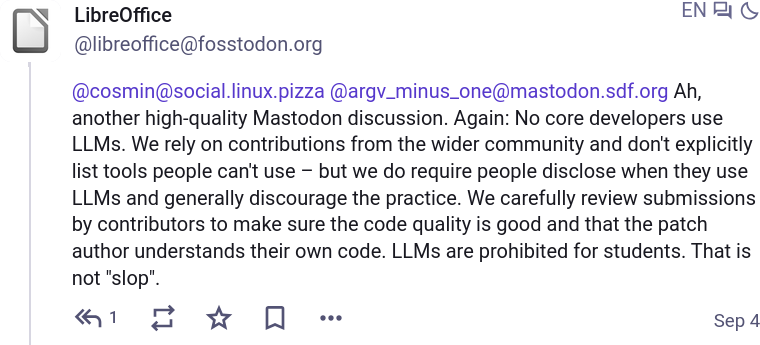
LibreOffice is now a project that uses chatbot code then tells people who call them out that slop is "not slop"
so much for the "no AI" babble
https://web.archive.org/web/20261026230500/https://fosstodon.org/@libreoffice/117214068793979843
Old Fucking Punk
boosted

Waiting 10 years to charge Comey with espionage says everything. The Espionage Act is so poorly written that it’s just a blank check to go after political rivals and whistleblowers.
The abuse won’t end until the law is reformed.
https://www.nytimes.com/2026/10/26/us/politics/james-comey-charges-doj.html
Old Fucking Punk
boosted

Books to Bewitch You
Get 40% of select titles, tarot decks, and merch with code WITCHY thru 11/1 here: https://www.pmpress.org/category/witchy-sale
Old Fucking Punk
boosted

There has never been a better time to introduce young French people to the wonderful world of decentralized social networks and - optional - #selfhosting.
An accidental ad for the #Fediverse, exhibit A: https://www.politico.eu/article/french-government-mulled-blocking-social-network-amid-protests/
Fuck the Democratic Party's centrism.
https://theintercept.com/2026/10/24/centrist-democrats-dsa-el-sayed/
"Carville told host Bill Kristol. “I would rather the Republicans keep the House by five than the Democrats to win by five, because, if that happens, they’re hostage to the DSA.”"
"Comedian Mike Drucker accurately described on Tuesday the centrist rejection of El-Sayed as less “blue no matter who” and more “blue unless brown.”"
#DumbAllOver
Old Fucking Punk
boosted

The Ultrawealthy Produce More Carbon Pollution Than Nearly Half of Humanity
https://time.com/article/2026/10/27/carbon-emissions-ultra-rich-oxfam-report/?utm_source=flipboard&utm_medium=activitypub
Posted into Top Stories @top-stories-time
Old Fucking Punk
boosted
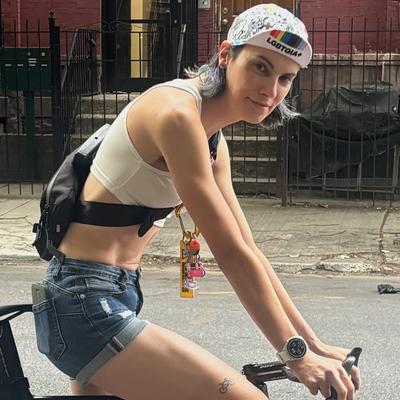
It might be appropriate to call voluntary AI users scabs. Stop feeding the machine dismantling our own labor! There isn't some basic income program. No utopia. Quality hasn't improved. Communities aren't healthier. The world isn't getting smarter.
Instead we have crumbling communities, loss of skill, a terrible job market, lack of trust with almost every interaction online, massive creative theft, and a dying planet. Yeah, these people are scabs.
This person states that they hate trust fund babies, and we don't need rich people. They also state they are in the business of creating trust fund babies. (I'm assuming that they somehow enable trust funds. ???)
https://beige.party/@HG/116511023065273930
This kind of reminds me of the Circle Jerks song, Making the Bombs. I understand hating your job, but I don't understand willingly enabling something you abhore. A life of crime seems more honest.
Old Fucking Punk
boosted

I work for and with rich people because they pay me lots to rent my brain. I have learned some things:
1. "Rich" is normally some combination of time, talent, luck, and fear. Luck is always one of the components. Rarely do my clients credit luck.
2. It does not take much money (relative) to become insulated from most consequences of daily life. That insulation rapidly severs people from people who work for a living.
3. People who inherit their wealth are contemptible. So are a lot of people who have worked for their money, but trust fund babies (who I am in the business of creating) have a strong tendency to be entitled, imperious, incompetent shits.
4. I'm really smart and really good at what I do. This is absolutely not a prerequisite for becoming rich and can even be counter-productive. Many of the people I work with are not particularly smart or talented, and that doesn't matter if you find a good racket and can sock away the money.
5. Back to people who inherit their money: as someone who will inherit basically a steak dinner and a heightened risk of Alzheimer's, I know nobody is coming to save me. I save as much as I can understanding that it may be a fool's errand. I resent people who have the luxury of knowing they cannot die from poverty because one day a mountain of dough is going to fall on them.
6. The estate tax should apply to as many people as possible and it should be confiscatory. Without it, we end up with these neo-feudalist enclaves of the corpulent rich, the grandchildren of ruthless/fortunate/gifted men, check-cashers who live off exploitation alone.
7. We do not need rich people.
Sorry, I'm in a mood. Endrant.
Old Fucking Punk
boosted



@hypha what’s worse is the original photo was just fine. https://eldritch.cafe/@ml/117508212048558879
Old Fucking Punk
boosted

“Don't think | deadSimpleTech”
https://deadsimpletech.com/blog/dont-think
> It's a show trial of thought: pre-determined conclusions, pre-determined axioms and premises, and all that's left for our thought leader to do is to apply the package to whatever particular issue they're curious about and do just enough casuistry to make everything hold together.
https://deadsimpletech.com/blog/dont-think
"The end result is that we live in a world that's deeply hostile to people who insist on thinking while demanding that they pretend to think."
Old Fucking Punk
boosted
Hey fedi friends, how do we feel about open plan offices? (We’re talking, not even much in the way of partitions between desks.)
Please boost for reach?
Old Fucking Punk
boosted

@psistarpsiii I think I'd have to find a new job.
Old Fucking Punk
boosted

SpaceX Whines About Space Collisions After Gutting Regulators That Oversee That Sort Of Thing - https://www.techdirt.com/2026/10/26/spacex-whines-about-space-collisions-after-gutting-regulators-that-oversee-that-sort-of-thing/
Old Fucking Punk
boosted

Hello from Open Culture's new home!
Our old server, toot.community, is shutting down, so we've moved to mastodon.social. If you followed us before, you should be following us again automatically. If you don't see us in your follows, just hit Follow.
We'll keep sharing free cultural and educational media from around the web. Thanks for coming along!
Old Fucking Punk
boosted

The term 'rando' is an homage to Ayn Rand, the patron saint of reply guys.
Old Fucking Punk
boosted

@grampajoe @aesthr I have searched my memories and the only things that came close to the attempts to force me to use chatbots / agents were:
- When I stopped eating meat, and 21 months later went vegan, those, mostly meat-eaters with a cognitive dissonance, who were warning me that I would be dead in 2 years if I didn't start eating meat again (it's been over 2 decades)
- When I was still "of childbearing age", those who were trying to convince me I would never know love unless I reproduced
- Christians of different denominations, but mostly Catholics (due to my growing up in Croatia), threatening me with hell unless I became a true believer
- the ex who would keep waking me up over and over again until I "consented" to sexual acts
Amway sellers, Herbalife sellers, Jehovah's witnesses, the friend who nudged me to drink at parties (and who gave up when I asked her what was her interest in me ingesting carcinogenic substances) were much less pushy. And nobody ever nudged me to try drugs other than alcohol.
Old Fucking Punk
boosted

@grampajoe
@aesthr
I feel like every genuinely useful tool I've ever worked with was adopted bottom-up, often with a lot of resistance. It makes sense, the people who actually do the work have a better idea of what tools are actually helpful.
Old Fucking Punk
boosted






Every one of these neo-nazi fucks in EVERY country where a right-wing exists are inextricably linked with A) violent goonsquads and B) the Republican Party of the United States and its neo-nazi techbro sponsors because they are ALL members of a Fascist International. This👇 is the START of how you MEANINGFULLY deal with them.
https://paydayreport.com/brazilian-federal-police-confiscate-flavio-bolsonaros-passport/
#ShlaerMellor, #FunctionPointAnalysis, #punk, #environmentalist, #unionAdvocate, #anarchosocialist #freeSoftwareAdvocate #cooperativeLife #noLLMs
"with a big old lie and a flag and a pie and a mom and a bible most folks are just liable to buy any line, any place, any time" - Frank Zappa
Joined May 2019