keverets @keverets@librem.one
Joined Jun 2019
It's insane how much AI bullshit one has to go through these days in order to find the answer to simple questions such as "how do I adjust the fill level on a korky fill valve?" from all major search engines.
The answer was https://m.youtube.com/watch?v=vqDi0NbnJ4A
Was not on top 10 anywhere.
keverets
boosted
People should be able to write software for Android, and distribute it outside Google's Play store, without having to:
* pay Google
* give government to with Google
* agree to Google terms and conditions
People should be able to install the software they want on their phone, from sources other than Google's Play store, without having to jump through Google-imposed hoops.
e.g. via F-Droid.
We've got until September this year to stop Google squeezing the open Android ecosystem.
keverets
boosted

Don’t be fooled by Ring’s latest attempt to make mass surveillance and real-time identification the new norm in our neighborhoods. https://www.eff.org/deeplinks/2026/02/no-one-including-our-furry-friends-will-be-safer-rings-surveillance-nightmare-0
keverets
boosted


"the European Payments Initiative (EPI) and the EuroPA Alliance signed a landmark agreement to build a pan-European interoperable payment network covering 130 million users across 13 countries. The system, built around the digital wallet Wero, aims to let Europeans pay and transfer money across borders without touching a single American network."
keverets
boosted

If Toyota pulls this off, it means EVs with 620 mile range with batteries that can be charged in 10 minutes in either 2027 or 2028. That's going to basically mean checkmate for all the competition unless they are equally innovative.
https://electrek.co/2026/02/09/big-oil-is-betting-big-on-toyota-to-win-the-solid-state-battery-race/
keverets
boosted

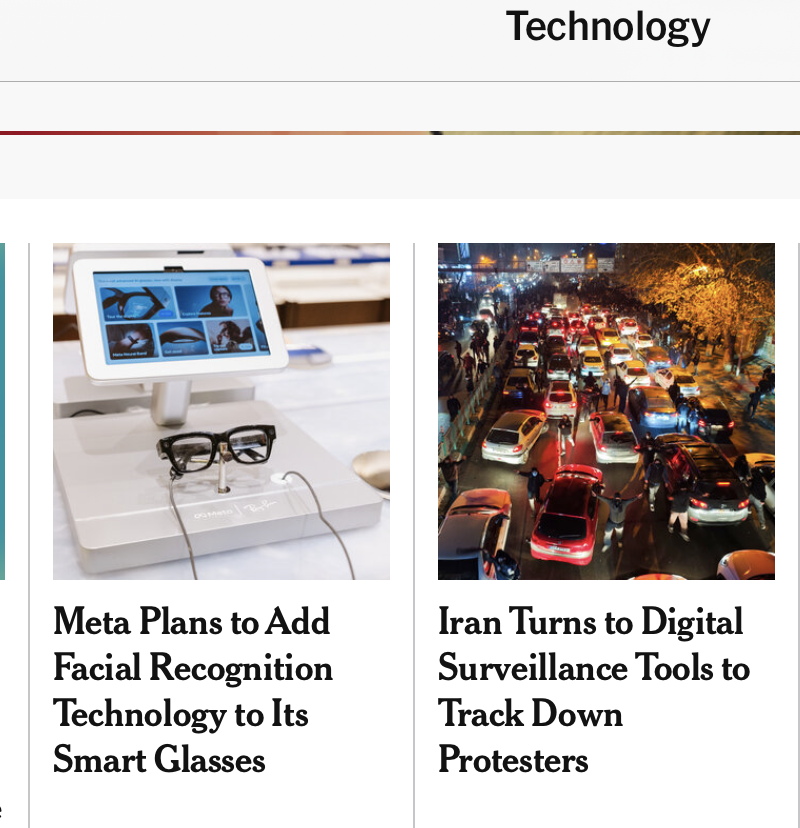
Two stories, side by side, in the NY Times Technology section.
@zverik thanks for sharing. Will try to do some ohome mapping that way too.
I stopped contributing to Mapillary once it was sold to Facebook, and have since started using panoramax instead (good to have servers and clients that are Free Software). I hope that gets better integration into people's editing workflow as well.
keverets
boosted

@rakoo you misunderstand my point. I'm not expecting an email client, but I am expecting distributed or self-hosted decentralization which the FAQ does not cover sufficiently.
@mntmn for the first issue, https://f-droid.org/packages/dev.robin.flip_2_dnd might be a work-around
Just installed @delta and was under the impression that it was email based. I expected to have to put in some email credentials and use my local email server. But instead it created a disconnected profile and just uses IMAP as a transport?
https://delta.chat/en/help does not make clear how this actually works.
Decentralised is a great buzz word, but without better description of how it works makes it difficult to trust.
https://delta.chat/en/help#security-audits doesn't mention architecture, just encryption.
keverets
boosted

This blogpost makes an astoundingly good case about LLMs I hadn't considered before. The collapse of public forums (like Stack Overflow) for programming answers coincides directly with the rise of programmers asking for answers from chatbots *directly*. Those debugging sessions become part of a training set that now *only private LLM corporations have access to*. This is something that "open models" seemingly can't easily fight. https://michiel.buddingh.eu/enclosure-feedback-loop
keverets
boosted

In our journey to #DigitalSovereignty, here's where we are:
- Domain registration: TransIP and Prolocation 🇳🇱
- Email, calendar, collaborative writing, and more: mailbox.org 🇩🇪
- Document store: Tresorit 🇨🇭
- Critical infra hosting: Hetzner 🇩🇪
- Discourse hosting: Communiteq 🇳🇱
- Security: 1Password.eu 🇨🇦/🇪🇺 and Yubico 🇸🇪
Next up: GitHub —> Codeberg 🇩🇪
To-do: Slack —> Zulip, Matrix, Mattermost?
keverets
boosted

👀 Big Tech is watching you!
But with some simple steps you can improve your privacy.
Follow our tips!
#Privacy
keverets
boosted

made a quick interactive map of building heights in toronto (2025 data)
big fan of tippecanoe->pmtiles->maplibre->github pages workflow, can pretty easily take a ~300mb .shp like this and render it all in-browser (no fancy db, server, or saas hosting)
https://schoolofcities.github.io/toronto-buildings/heights-2025
keverets
boosted

If you put the Apple icons in reverse it looks like the portfolio of someone getting really really good at icon design
keverets
boosted
Google, Meta, and Amazon are among the top companies tracking you across the web. By automatically blocking their trackers, Privacy Badger makes it harder for Big Tech companies to profit from your personal information. https://www.eff.org/deeplinks/2025/03/online-tracking-out-control-privacy-badger-can-help-you-fight-back
keverets
boosted
Home for the holidays? Help your loved ones install Privacy Badger to stop online trackers from following them around the web. https://privacybadger.org/
keverets
boosted





The issue of comparison is exactly why this is all interesting, though! If NIST completely loses the clocks at Boulder, they will need to 'restart' them later by synchronizing them to some other standard like another NIST site or the Navy. The physical distance between locations and means of comparing their time signals makes this a tricky process, and one that I don't think the Boulder clocks have ever been through before.
The gold standard used to be to literally "ship" the time reference, by flying a portable atomic clock between sites. I know that NIST has fiber lines between sites and metrology has continued to advance, my impression is that you can now get more accurate results by sending signals over precisely measured fiber. But if NIST does end up in that scenario I'm sure we'll get a paper about how exactly they end up handling it.
Joined Jun 2019