

UnlistedStepInside @artiom@librem.one
USSR ⇾ Ukraine ⇾ France ⇾ Singapore ⇾ United Kingdom ⇾ France ⇾ Australia ⇾ Japan ⇾ Australia ⇾ ?
🇫🇷🇦🇺🇺🇦

This one is also bang on:
https://youtu.be/JtBI2BvPKBQ

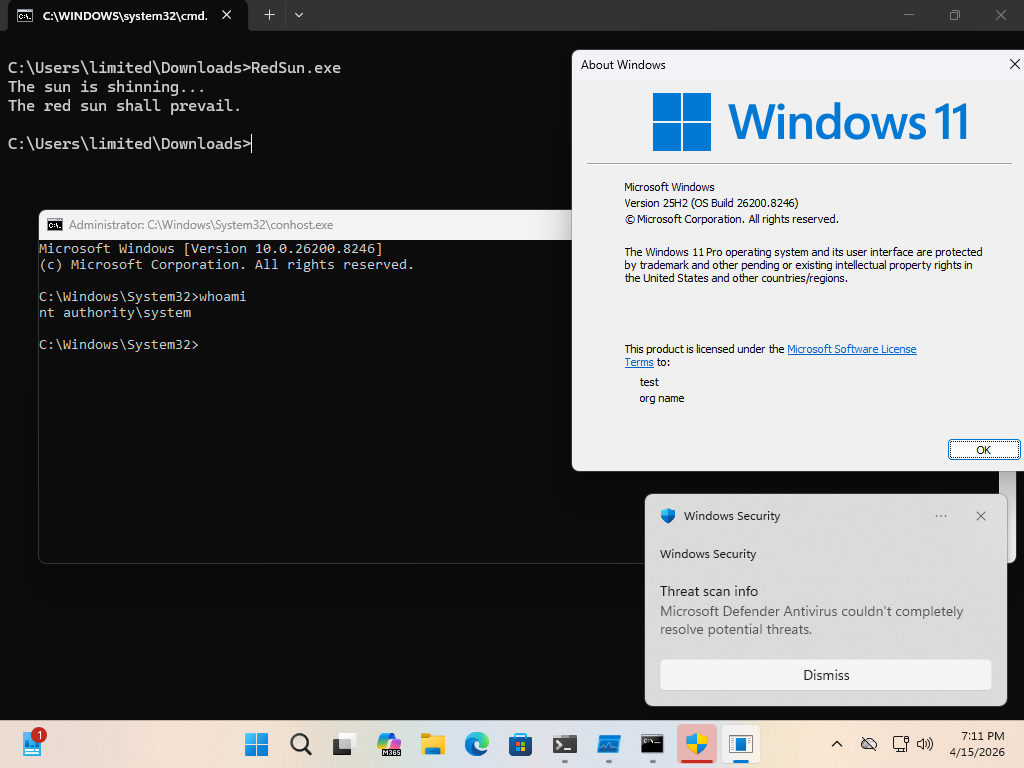
From the same author as BlueHammer we now have RedSun.
This works 100% reliably to go from unprivileged user to SYSTEM against Windows 11 and Windows Server with April 2026 updates, as well as Windows 10.

Modern, scientific man has written women out of history
Half of Japan’s samurai were women, groundbreaking new exhibition at British Museum says
https://www.independent.co.uk/asia/japan/british-museum-samurai-women-warrior-myth-b2913476.html
The Viking Woman Warrior of Birka, Sweden
https://www.history-channel.org/a-viking-mystery-the-woman-warrior-of-birka/
Early Women Were Hunters, Not Just Gatherers
https://www.smithsonianmag.com/smart-news/early-women-were-hunters-not-just-gatherers-study-suggests-180982459/
‘Woman the hunter’: Studies aim to correct history
https://news.nd.edu/news/woman-the-hunter-studies-aim-to-correct-history/
The sports where women outperform men
https://www.bbc.com/future/article/20240731-the-sports-where-women-outperform-men
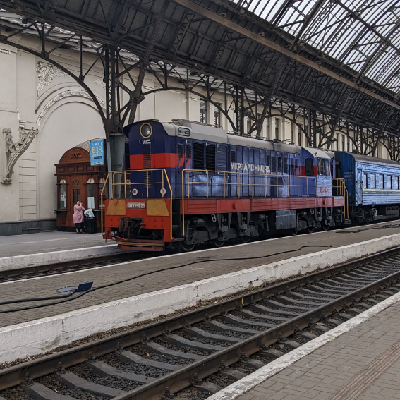
 - solidarity with
I can't believe how Europe, Australia and pretty much everywhere else people believe the propaganda about China's supposedly amazing railway network and rolling stock industry, shared all over the place by the dictatorship's business initiatives.
It hurts my soul to defend Alstom, Siemens or Stadler but if you every looked closer to a CRRC train, you will soon understand how European rolling stock is decades ahead of what China builds.
Let me explain and start with the economics.
- Westbahn ordered 15 Stadler KISS trains for 300 mio EUR (20 mio per trainset)
- Westbahn leased four CRRC DDMU02 trains for 70 mio EUR for a period of 10 years including maintenance (18 mio EUR per trainset)
- Leo Express ordered five Stadler FLIRT trains for 60 mio EUR (12 mio per trainset)
- Leo Express ordered three CRRC Sirius trains for 200 mio EUR (70 mio per trainset)
We keep hearing how European manufacturers cannot compete with Chinese prices. Yes, the trains are cheap and the overall offers good - but there is definitely no unreasonable price gap. And all that despite CRRC as a state-owned enterprise profiting from any kind of financial and political support, humans rights violating exploitation in the employees and large scale forced labor in the supply chain.
But if we compare the prices, it's not such a huge difference. The key factor is rather the delivery time : As a Chinese state company, the priority is always supplying foreign offers first in hope to permanently establish a supply chain. Therefore, CRRC can immediately start building newly ordered trains - a lure offer to establish China on international markets.
So far the business side.
Let's talk about the rolling stock itself.
As a brief history, CRRC was established from the so-called "Harmony" (Hexie) initiative of China's dictatorship regime. Hexie refers to the first generation of Chinese high-speed trains built by European and Japanese companies locally in China using technology-transfer. This way, CRRC got all the knowledge from Alstom, Bombardier, Kawasaki and Siemens to develop their own future trains.
Chinese trains are incredibly fast and amazing press pictures, mock-ups and even prototypes carrying to narrative of comfortable, modern and affordable trains dominate the western view on Chinese railways. These narratives are repeated, prayed over and over with no evidence.
Yes, trains are fast. That's it. CRRC has combined and improved the foreign technology to operate at higher speeds of 350 - 400 kph. The rest of it is propaganda. The trains technology is not advanced. The trains are bumpy, unoptimized and shaky - even on the most modern tracks at medium speed. The hardware is unreliable, everything is optimized on low cost, neither on safety nor on quality and sustainability.
Despite that, railways are incredibly expensive in China. They are configured in budget airline style with the cheapest interior possible in 1st and 2nd class. The exception is the business class (surprise : That's what the propaganda machine feeds to the international news). While we believe the song of affordable railways accessible to everyone, tickets here are at the same price and often more expensive than on the flagship high-speed networks in Europe - absolutely unaffordable for the average Chinese citizen who's not living a privileged higher class life.
I don't know why we all believe this, but seeing western companies falling into the trap of CRRC's lure offers for cheap trains is entirely incomprehensive to me. Chinese rolling stock is not the long awaited new wind for modern and affordable railways but a pitfall into the scrapyard of deprecated, crappy and unthoughtfully built rolling stock covered by a beautiful mask and pipe dreams.
Crappy trains sold at over expensive prices despite the dictatorship's government subsidies, cruel exploitation of the workers and forced labor in the supply chains.
China is not just a business partner with another culture. It's a cruel dictatorship putting all effort in propaganda, business and dependency of the western world.
If we're serious about railways, about liberty and human rights, we buy rolling stock in democratic countries with worker's rights, independent human rights organizations and real innovation in building trains.
China is not an alternative source of rolling stock but a cruel dictatorship eliminating its own population in concentration camps and supporting slavery through forced labor to reach its economic power.
All information in this post was researched at best effort. I'm not a train manufacturer not an economist or human-rights expert. I'm just an individual concerned about what's happening. Especially the human-rights situation in China is hard to proof due to the absolute surveillance and repression against anyone speaking up.
Cynically, I wrote this post while traveling aboard of a  CR400AF-Z train in China.

@lumi GrapheneOS is based on the Android Open Source Project which doesn't have Google apps and doesn't use their regular services. It only uses Google as a provider for very basic standard services which we replaced in GrapheneOS.
The purpose of GrapheneOS isn't specifically avoiding Google apps and services but rather providing a high level of privacy and security in general. Using Pixels is not in any way counter to our goals. We want official OEM support, lower level hardening, etc. though.

I'm looking forward to presenting my paper, "Continuous User Behavior Monitoring using DNS Cache Timing Attacks" at NDSS next week!
We mount an Evict+Reload-style attack on the local DNS cache, detecting recently accessed domains and evicting to continuously monitor new accesses.
Our attack works from native code, even across virtual machines and containers.
We also run the attack in the browser from a malicious website, using JavaScript or even scriptless HTML+CSS.
Most underlying primitives are OS-agnostic!
Read the paper here: https://hannesweissteiner.com/publications/dmt/
Thanks to Roland Czerny, @silent_bits, @notbobbytables , Johanna Ullrich and @lavados for the amazing collaboration!

the UNIX v4 tape reminded me of this story by Ali Akurgal about Turkish bureaucracy:
Do you know what the unit of software is? A meter! Do you know why? In 1992, we did our first software export at Netaş. We wrote the software, pressed a button, and via the satellite dish on the roof, at the incredible speed of 128 kb/s, we sent it to England. We sent the invoice by postal mail. $2M arrived at the bank. 3-4 months passed, and tax inspectors came. They said, “You sent an invoice for $2M?” “Yes,” we said. “This money has been paid?” they asked. “Yes,” we said. “But there is no goods export; this is fictitious export,” they said! So we took the tax inspectors to R&D and sat them in front of a computer. “Would you press this ‘Enter’ key?” we asked. One of them pressed it, then asked, “What happened?” “You just made a $300k export, and we’ll send its invoice too, and that will be paid as well,” we said. The man felt terrible because he had become an accomplice! Then we explained how software is written, what a satellite connection is, and how much this is worth. They said, “We understand, but there has to be a physical goods export; that’s what the regulations require.” So we said: “Let’s record this software onto tape (there were no CDs back then—nor cassettes; we used ½-inch tapes) and send that.” Happy to have found a solution, they said, “Okay, record it and send it.” The software filled two reels, which were handed to a customs broker, who took them to customs and started the export procedure. The customs officer processed things and at one point asked, “Where are the trucks?” The broker said, “There are no trucks—this is all there is,” and pointed to the tape reels on the desk. The customs officer said, “These two envelopes can’t be worth $2M; I can’t process this.” We went to court, an expert committee examined whether the two reels were worth $2M. Fortunately, they ruled that they were, and we were saved from the charge of fictitious export. The same broker took the same two reels to the same customs officer, with the court ruling, and restarted the procedure. However, during the process, the unit price, quantity, and total price of the exported goods had to be entered—as per the regulations. To avoid dragging things out further, they looked at the envelope, saw that it contained tape, estimated how many meters of tape there are on one reel, and concluded that we had exported 1k to 2k meters of software. So the unit of software became the meter.
3. Attempts to be more specific and elaborate don't work. They only provide control surfaces for shit-stirrers to manipulate.
Yes, we should try to be kind to each other. But we should be ruthless and merciless towards people who try to turn "Be kind!" into a weapon. Indulging them never ends well.
Eric S. Raymond
Here is my advice about codes of conduct:
1. Refuse to have one. If your project has one, delete it. The only actual function they have is as a tool in the hands of shit-stirrers.
2. If you're stuck with having one for bureaucratic reasons, replace it with the following sentence or some close equivalent: "If you are more annoying to work with than your contributions justify, you'll be ejected."
Eric S. Raymond
I'm about to do something I think I've never done before, which is assert every bit of whatever authority I have as the person who discovered and wrote down the rules of open source.
After ten years of drama and idiocy, lots of people other than me are now willing to say in public that "Codes of Conduct" have been a disaster - a kind of infectious social insanity producing lots of drama and politics and backbiting, and negative useful work.
Eric S. Raymond

ENLIGHTENMENT NARRATIVE
capital smokescreen




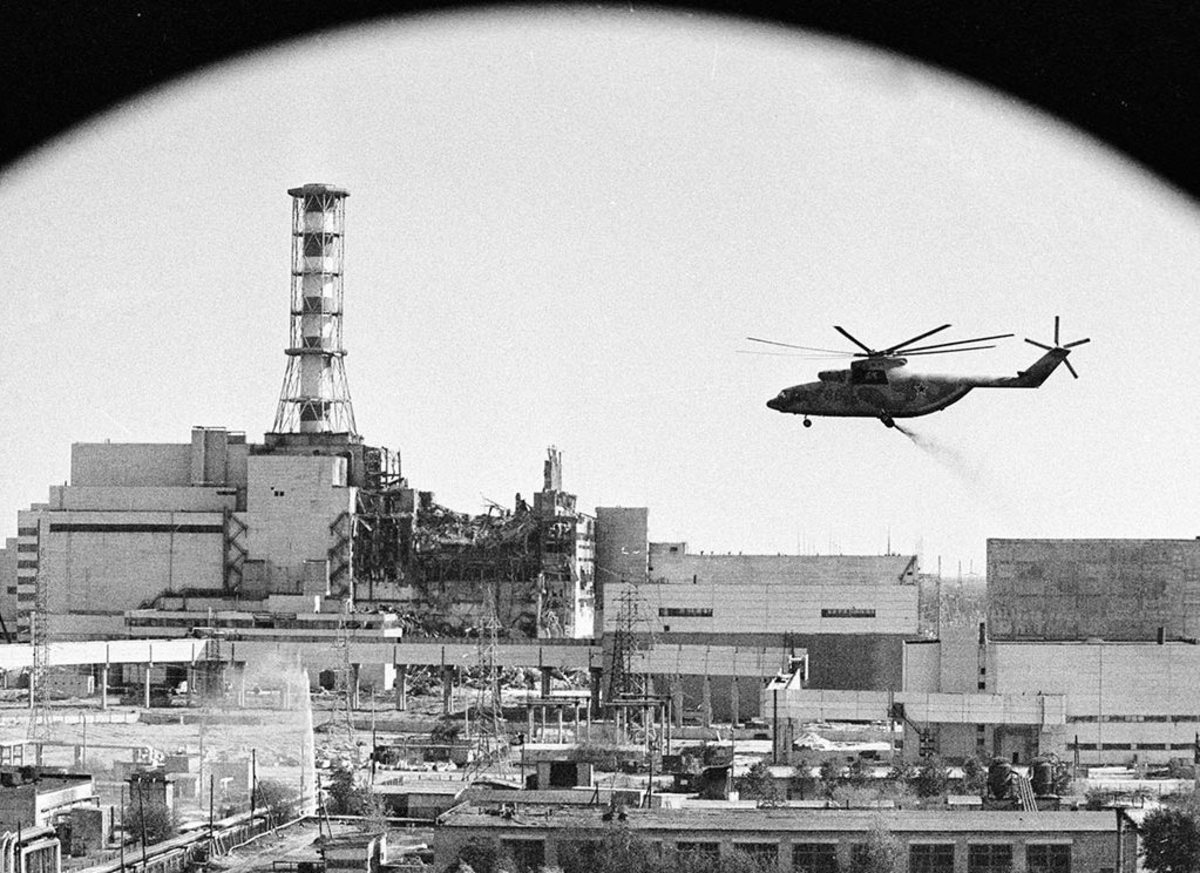
On 29 July 1987 the trial of #Chernobyl plant leadership ended with 10 years sentences for the director Bryukhanov, head of engineering Fomin and his deputy Dyatlov.
This ruling was a classic example of the Soviet “legal system” - the people convicted were formally responsible for the decisions that led to the disaster, but they were not the decision makers.
The primary responsibility for the disaster was on the local (Kiev) and central (Moscow) Communist Party authorities who insisted on conducting the planned reactor test in spite of its known faults, specifically because it was planned. In #USSR the Plan was absolutely sacred and built from top to bottom, in detachment of any physical reality. Executive level not following the Plan was subject to criminal charges based on article 58 of the RSFSR Criminal Code (“sabotage” and others). The Party leadership insisted on the testing to be conducted in spite of the plant management - the one who was convicted - asking to postpone it due to reactor faults.
The faults in reactor were known for a long time by its designer and manufacturer - the Kurchatov Institute of Atomic Energy (NIKIET) - who however chose to hide them because, if revealed, they would hamper their own Plan. Therefore reactor operating procedures, closely followed by the plant staff during the tragic test, did not account for the faults.
In the period immediately following the reactor explosion and fire, local Party officials actively blocked emergency response and dismissed the impact in their communication to Moscow - once again, because that would negatively impact their careers. None of them were actually convicted, of course.
So if you want an example in corporate greed and dysfunctional management leading to world-scale environmental disaster, the Soviet management of Chernobyl makes a perfect case study. Except nobody uses it, because USSR had “Socialist” in its name so when they caused an environmental disaster that must have been, naturally, a “honest mistake” that had nothing to do with incompetence or greed 🤷
If you want a book that documents all of the above details - which are usually skipped in most narratives about Chernobyl - I can recommend a 2019 book “Midnight in Chernobyl” by Adam Higginbotham which uses tons of Soviet original documents to show what has really happened there and why.
USSR ⇾ Ukraine ⇾ France ⇾ Singapore ⇾ United Kingdom ⇾ France ⇾ Australia ⇾ Japan ⇾ Australia ⇾ ?
🇫🇷🇦🇺🇺🇦